The warning highlights rising issues about AI-driven automation throughout finance, consulting, expertise, and authorized companies, the place companies more and more depend on clever programs to deal with duties beforehand assigned to junior staff.
AI Developments Put Entry-Stage White-Collar Jobs at Threat
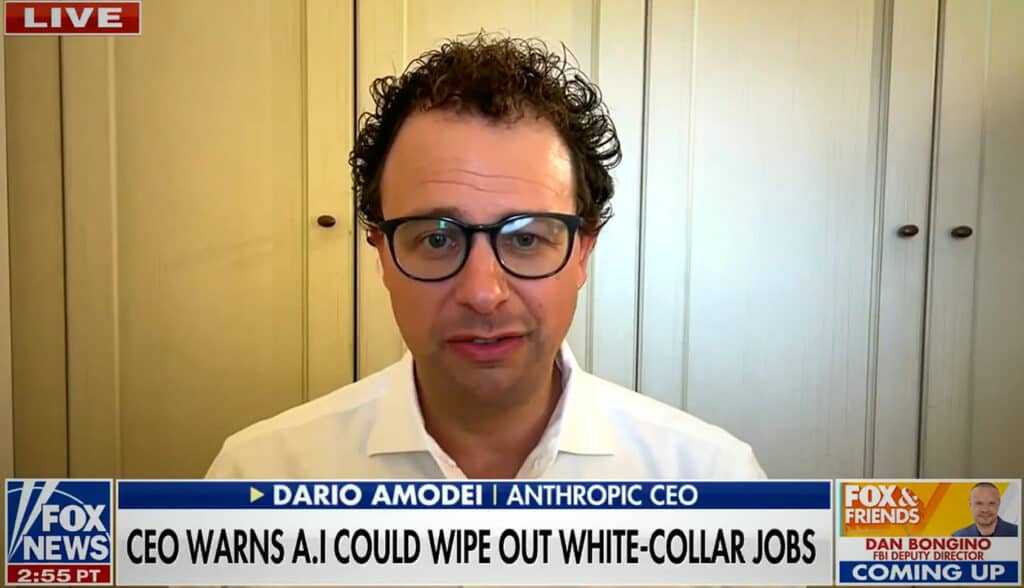
Talking in a Fox Information interview printed on Might 19, 2026, Amodei described how rapidly synthetic intelligence capabilities have improved, warning that the expertise is approaching a stage the place it might tackle extra advanced skilled duties.
“Two years in the past, it was on the stage of a wise highschool scholar; now it’s in all probability on the stage of a wise faculty scholar and reaching past that,” he stated.
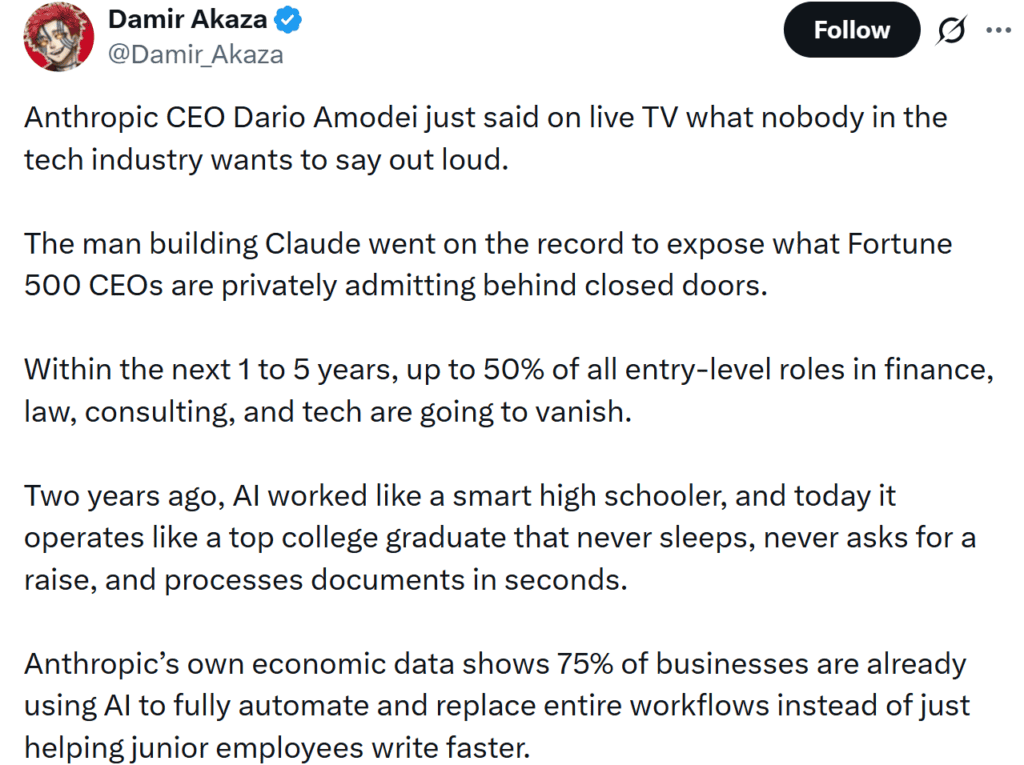
Anthropic’s information signifies that 75% of companies are already utilizing AI to automate complete workflows reasonably than merely helping staff with routine duties. Supply: @Damir_Akaza/X
The Anthropic CEO recognized routine knowledge-based actions, together with doc summaries, brainstorming, and monetary report preparation, as duties the place AI programs have gotten more and more succesful. These duties usually type the muse of entry-level positions, significantly in industries that rely closely on analysis, evaluation, and doc processing.
Amodei warned that AI might initially help staff earlier than taking on a bigger share of their duties.
“Issues like summarizing a doc, brainstorming, placing collectively a monetary report, makes me fear rather a lot that entry-level jobs in areas like finance, consulting, tech, many, many different areas like that, entry-level white-collar work,” he stated.
He added that these positions might finally get replaced by AI programs as their capabilities enhance.
The manager additionally acknowledged uncertainty surrounding the tempo of adoption however warned that vital employment adjustments might emerge comparatively rapidly.
“I’d not be shocked if someplace between one and 5 years, we began to see huge results right here,” Amodei stated.
He described the potential penalties as a “critical employment disaster” if the standard pipeline into skilled careers begins to contract.
AI Automation Is Transferring Past Fundamental Office Help
The concerns prolong past particular person productiveness instruments. Companies are more and more exploring AI brokers able to executing a number of phases of a workflow with restricted human intervention.
Anthropic’s September 2025 Financial Index report gives perception into this transition. The corporate analyzed its first-party software programming interface (API) visitors and located that 77% of enterprise makes use of concerned automation patterns, in contrast with roughly 50% of interactions on Claude’s client platform.
Amodei says AI is advancing towards graduate-level capabilities, accelerating the shift from worker help to routine job alternative. Supply: Damir Akaza by way of X
The excellence is necessary as a result of API-based enterprise functions permit organizations to combine AI capabilities immediately into their present software program and operational programs. As a substitute of merely asking a chatbot to summarize info, corporations can use these integrations to delegate full duties.
Anthropic’s findings counsel that companies are more and more treating AI as an operational instrument reasonably than relying solely on human-AI collaboration.
Its 2026 State of AI Brokers report supplies additional proof of this shift. A survey of greater than 500 technical leaders discovered that 57% of taking part organizations already deployed AI brokers for multistage workflows. In the meantime, 81% deliberate to pursue extra advanced AI functions throughout 2026.
These functions embrace analysis, information evaluation, report era, and inner course of automation.
Such developments might change how organizations construction their departments. Duties beforehand divided amongst a number of junior staff might more and more be dealt with by automated programs, leaving smaller groups chargeable for reviewing outcomes, managing operations and making selections.
Nonetheless, automation adoption doesn’t robotically translate into an equal variety of job cuts. Corporations should additionally account for implementation prices, accuracy, regulatory necessities, and the necessity for human oversight.
Anthropic’s Personal Hiring Patterns Reveal an Early Shift
Anthropic’s inner employment information supplies one other perspective on how AI adoption might reshape company hiring.
In an October 16, 2026 analysis report titled How Employment Is Altering at Anthropic, the corporate examined its hiring patterns, workforce composition, productiveness, and inner use of AI brokers.
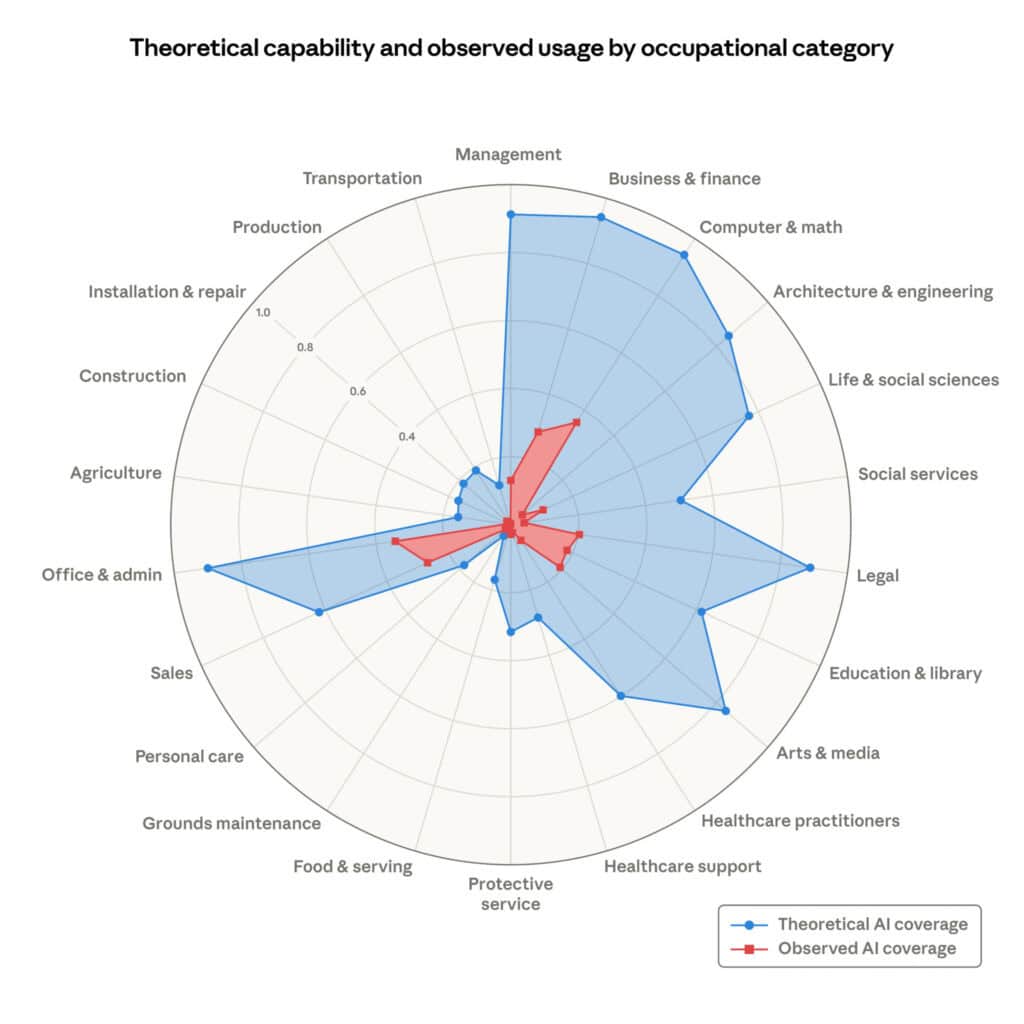
Anthropic’s observed-exposure metric compares AI’s theoretical job-task capabilities with precise utilization, exhibiting Claude handles 33% of laptop and math duties regardless of a possible 94% protection. Supply: @thesupermannx by way of X
The analysis discovered that junior-level staff accounted for 14% of Anthropic’s technical workforce, down from 21% in early 2025. The share of junior staff amongst new technical hires declined even additional, falling from 27% to 9%.
Anthropic attributed a part of the change to improved AI capabilities, significantly in software program growth, the place staff more and more delegate coding and debugging duties to AI brokers.
The analysis additionally discovered that round one-third of machine-learning managers and one-fifth of software-engineering managers reported hiring fewer staff due to AI in an April 2026 survey.
Nonetheless, the findings don’t point out that Anthropic has stopped increasing its technical workforce. The corporate’s absolute technical headcount continued rising, whereas hiring in gross sales, finance, and recruiting elevated at a quicker tempo.
The report additionally described adjustments within the duties of present staff. Employees more and more spend time directing AI agents, checking their output, and constructing instruments that assist coordinate automated processes.
This growth means that AI adoption might reshape job necessities even when positions stay obtainable. Staff might more and more want abilities in crucial pondering, decision-making, and managing automated programs reasonably than focusing solely on routine technical execution.
AI Job Displacement Stays an Unsure Outlook
Regardless of rising automation capabilities, proof of widespread AI-driven unemployment stays restricted.
Anthropic’s March 2026 labor market examine launched an occupational publicity measure combining theoretical AI capabilities with precise utilization patterns. It discovered that laptop and mathematical occupations had the potential for AI to speed up 94% of their duties, but noticed AI protection accounted for roughly 33%.
This hole signifies that technical functionality doesn’t robotically translate into widespread office alternative. Authorized necessities, software program integration, organizational processes, and human verification can all gradual adoption.
Unbiased analysis has recognized potential stress on youthful staff coming into extremely uncovered occupations.
A Stanford Digital Financial system Lab examine, revised in August 2026, analyzed payroll info protecting tens of millions of US staff by means of June. It discovered that employment amongst staff aged 22 to 25 in AI-exposed occupations was 19% under the extent it will have reached if it had adopted employment traits amongst less-exposed friends.
The researchers discovered that decreased hiring, reasonably than elevated worker separations, accounted for a lot of the distinction. Nonetheless, they cautioned that the findings characterize early indicators reasonably than definitive proof that AI precipitated the employment hole. The examine additionally discovered no proof of widespread economy-wide job displacement.
Equally, the Yale Finances Lab’s October 14, 2026 labor market replace discovered no clear proof of large-scale employment disruption related to AI in its evaluation of September employment information.
These findings counsel that the instant problem could also be a slowdown in recruitment alternatives for youthful staff reasonably than mass layoffs throughout all the white-collar workforce.
Making ready for an AI-Pushed Labor Market
Amodei believes companies, staff, and governments should start addressing the employment dangers related to more and more succesful AI programs.
Throughout the Fox Information interview, he argued that stopping technological growth can be troublesome due to worldwide competitors, significantly between america and China. As a substitute, he emphasised the significance of getting ready staff and measuring the financial penalties of AI adoption.
He additionally advised that governments might finally want to think about insurance policies that assist distribute the financial advantages of AI extra broadly, together with the potential of taxing AI corporations.
For workers, the transition might require adapting to a office the place AI handles a rising share of routine digital duties. Familiarity with prompting alone might not be sufficient as companies undertake autonomous brokers able to performing interconnected duties.
Understanding the best way to combine AI into skilled workflows, consider its output, and oversee automated processes might develop into more and more necessary throughout a number of industries.
However, the long-term consequences will rely upon how rapidly corporations deploy these programs, how a lot human supervision stays mandatory, and whether or not new employment alternatives emerge alongside automation.
Amodei’s warning locations the way forward for entry-level white-collar employment on the heart of the AI debate. Whether or not his projection materializes stays unsure, however the altering hiring patterns and rising adoption of AI brokers point out that companies are already reconsidering how skilled work will get performed.
Ahmed Ishtiaque Ahmed Ishtiaque Read More