
Michael Saylor has revived expectations of one other Bitcoin acquisition by Technique after sharing its long-term accumulation chart. Ethereum co-founder Vitalik Buterin, in the meantime, has challenged the funding argument constructed round ETH’s fee-burning mechanism. At Ripple, former chief expertise officer David Schwartz has responded to criticism over XRP’s declining worth, describing his private affect as very restricted.
Michael Saylor’s Bitcoin Chart Fuels New Buy Hypothesis
Michael Saylor renewed hypothesis about Technique’s Bitcoin accumulation plans on November Eight after posting a chart from SaylorTracker.com. Captioned “Connecting the dots,” the visualization confirmed the corporate’s Bitcoin treasury valued at roughly $64.44 billion, with 849,327 BTC held throughout 120 buy occasions.
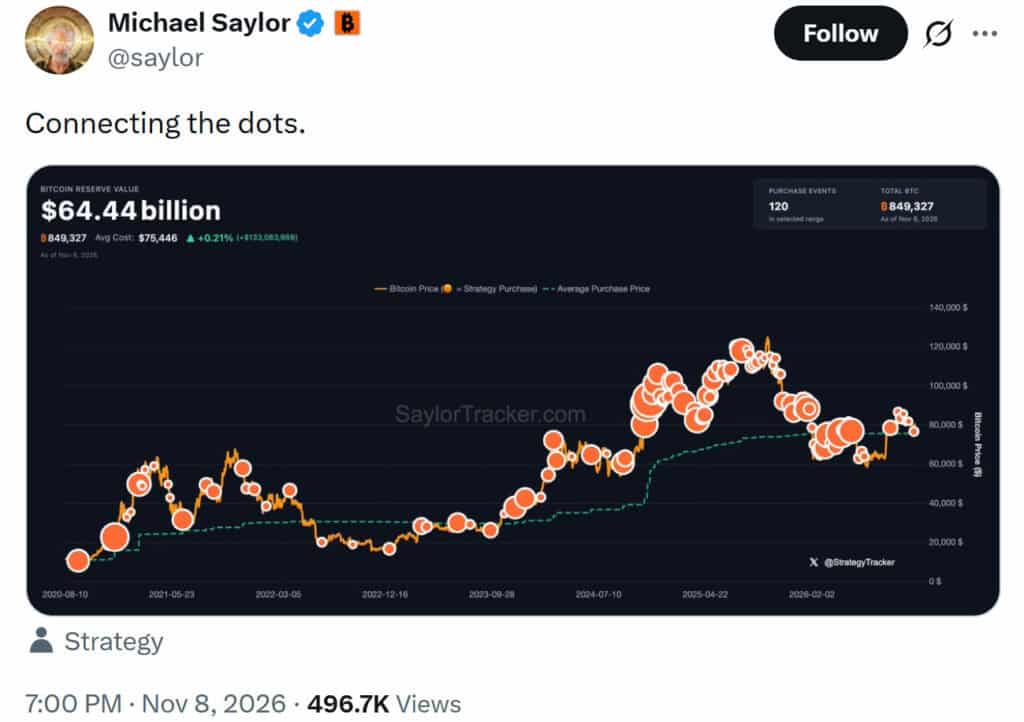
The visualization tracks 120 Bitcoin purchases in opposition to historic worth actions, highlighting the corporate’s constant accumulation technique throughout market cycles. Supply: Michael Saylor through X
The chart traced Technique’s acquisition historical past in opposition to Bitcoin’s price movements, illustrating how the corporate continued accumulating the cryptocurrency by way of totally different market circumstances. It listed a mean acquisition price of roughly $75,446 per BTC, highlighting the size of the corporate’s long-term treasury technique.
Though Saylor’s publish attracted consideration from buyers anticipating one other buy, it didn’t verify a brand new transaction. He has often shared comparable accumulation updates earlier than Technique releases its weekly Bitcoin acquisition disclosures. The most recent message due to this fact raised expectations slightly than establishing that one other buy had taken place.
The publish adopted Technique’s November 2 announcement that it had acquired 811 BTC for about $65.5 million between October 26 and November 1. In line with the corporate’s SEC submitting, the acquisition introduced complete holdings to 849,327 BTC, acquired for an combination $64.08 billion at a mean price of $75,451 per coin.
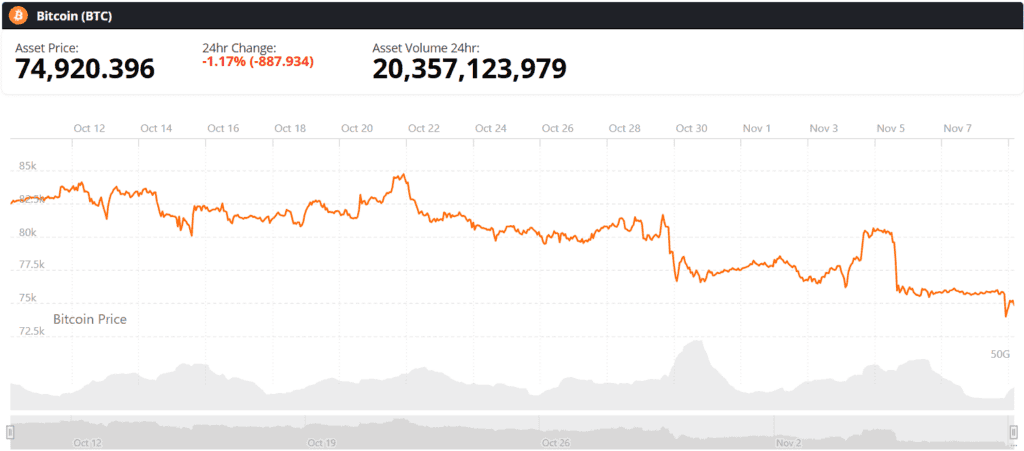
Bitcoin (BTC) worth chart. Supply: Brave New Coin
Technique additionally repurchased roughly $208.2 million price of its STRC most popular shares throughout the identical reporting interval. The corporate used its present dollar-denominated money for the repurchase, whereas proceeds from promoting 1,178,552 MSTR frequent shares helped finance the Bitcoin acquisition. The share gross sales generated roughly $164 million, of which $65.5 million funded the acquisition and the remaining $98.5 million went towards its money steadiness.
Saylor’s exercise round STRC has additionally drawn consideration to Technique’s broader financing construction. The popular safety, traded on Nasdaq below the ticker STRC, types a part of the corporate’s digital credit score technique. Saylor mentioned the monetary foundations of the product in a separate November 7 publish, writing that “Digital credit score took 4 centuries to make doable.”
Buyers will now look to Technique’s subsequent official disclosure for affirmation of any extra Bitcoin purchases. Till the corporate reviews one other transaction, Saylor’s newest chart stays a sign of its established accumulation strategy slightly than proof of a brand new acquisition.
Vitalik Buterin Questions Ethereum’s Price-Burning Valuation Mannequin
Ethereum co-founder Vitalik Buterin has challenged the concept that ETH’s long-term market value ought to rely totally on transaction-fee burning. He believes positioning the asset as a retailer of worth affords a extra reliable funding narrative than treating token destruction as the first supply of its financial price.
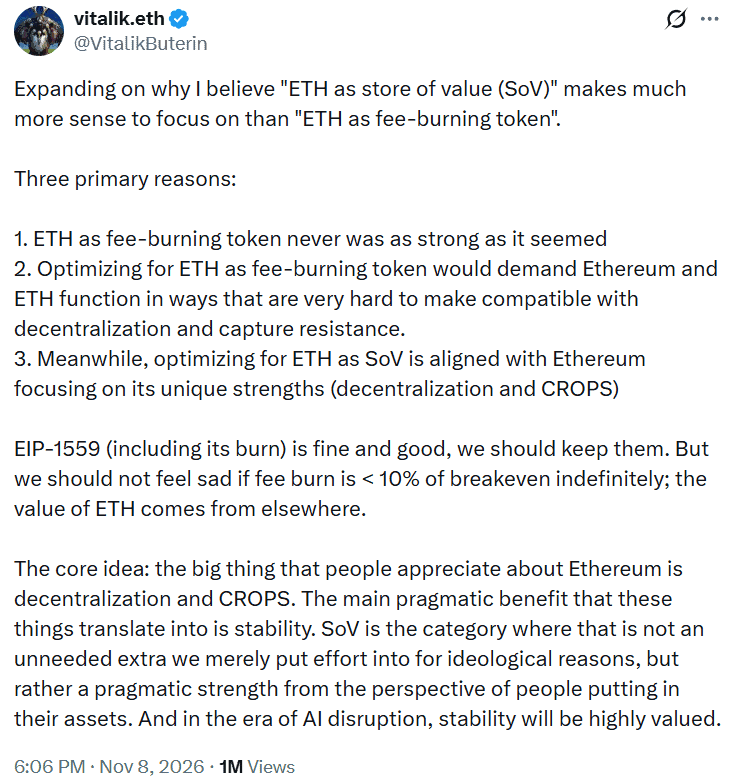
Vitalik Buterin favors ETH as a retailer of worth over a fee-burning token, citing Ethereum’s core ideas of decentralization, privateness, and safety. Supply: @VitalikButerin through X
The controversy facilities on EIP-1559, Ethereum’s 2021 improve that launched a mechanism for completely eradicating the bottom portion of transaction charges from circulation. When the quantity of ETH burned exceeds the issuance paid to validators, the community’s complete provide can decline. This mechanism helped set up the “ultrasound cash” narrative amongst buyers throughout the earlier bull market.
Buterin questioned whether or not the mechanism offers a dependable valuation ground. He illustrated the standard argument with a hypothetical community producing $1 billion in annual token burns. Making use of a 4% low cost charge would produce an estimated valuation of $25 billion below that mannequin.
Nonetheless, Buterin argued that this calculation assumes the underlying income stays reliable. Ethereum’s historic payment technology has been closely influenced by exercise throughout the cryptocurrency market itself. Speculative buying and selling, NFT launches, and different durations of intense on-chain demand have produced unusually excessive transaction prices, however these circumstances can fade when market sentiment weakens.
The Otherside NFT land sale in 2022 supplied one instance of this volatility. The occasion generated an distinctive spike in Ethereum transaction charges, demonstrating how a single speculative episode may briefly enhance token burning. Buterin argued that such exercise doesn’t essentially present the steady exterior income required to ascertain an enduring valuation ground.
He additionally maintained that Ethereum mustn’t abandon EIP-1559. As an alternative, he steered that buyers shouldn’t be involved if payment burning stays under the extent wanted to offset new ETH issuance. As he defined, “the worth of ETH comes from elsewhere.”
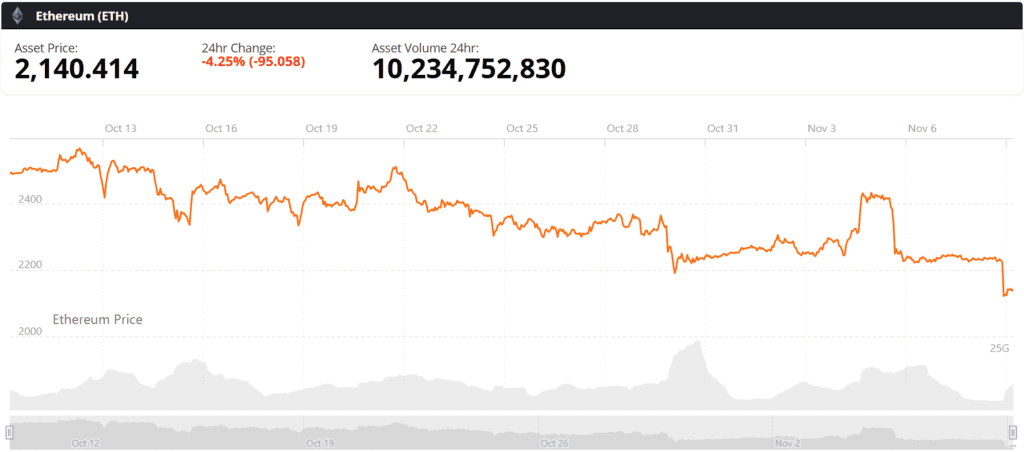
Ethereum (ETH) worth chart. Supply: Brave New Coin
Buterin recognized decentralization, censorship resistance, open-source improvement, privateness, and safety as extra vital foundations for Ethereum’s long-term enchantment. He additionally warned that making an attempt to maximise transaction-fee income may push the community towards greater gasoline costs, intensive protocol spending, and extra interventionist governance.
Such adjustments may undermine the traits that distinguish Ethereum from conventional monetary infrastructure. Larger transaction prices may additionally make the community much less accessible to customers who rely on privateness and safety.
His store-of-value argument additionally considers the community’s potential function in supporting tokenized real-world belongings. Higher adoption of belongings issued straight on Ethereum’s base layer may give ETH extra utility as collateral whereas strengthening its place throughout the monetary ecosystem. Buterin additional emphasised long-term community survival, together with safety enhancements and preparation for post-quantum cryptography.
The feedback symbolize a change in emphasis slightly than a proposal to take away Ethereum’s present fee-burning mechanism. Buterin’s broader argument is that ETH ought to derive its funding enchantment from the sturdiness and reliability of its underlying infrastructure, slightly than relying on unpredictable durations of elevated transaction exercise.
David Schwartz Downplays His Affect Over XRP Worth
Ripple’s former chief expertise officer David Schwartz has addressed renewed criticism from XRP holders following the token’s extended decline. His response got here after cryptocurrency commentator Digital Asset Investor highlighted an change involving Schwartz on X, the place buyers questioned whether or not he had any accountability for XRP’s market performance.
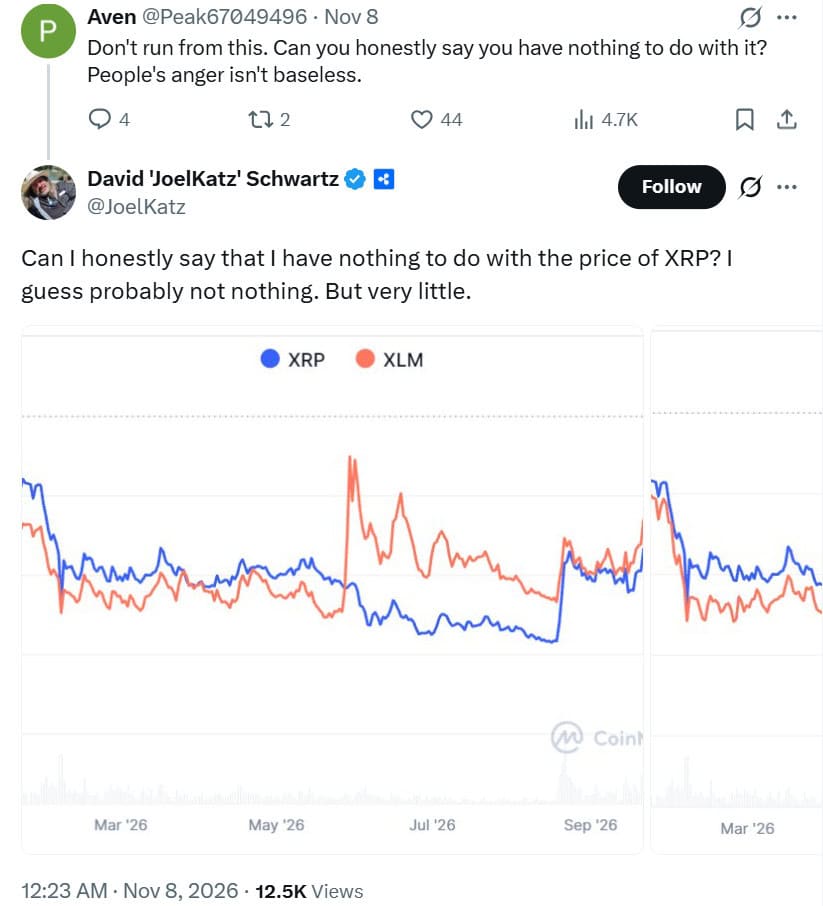
Schwartz says his affect over XRP’s worth is minimal regardless of accusations of accountability. Supply: @JoelKatz through X
One person challenged Schwartz to acknowledge his connection to the token’s worth, arguing that holders’ frustration was not with out purpose. Schwartz responded candidly when requested whether or not he may truthfully declare to haven’t any affect over XRP.
“Can I truthfully say that I’ve nothing to do with the worth of XRP? I assume most likely not nothing. However little or no,” he replied.
The assertion acknowledged that his actions and public feedback could have some affect, whereas rejecting the concept that he has substantial management over XRP’s market valuation. The change didn’t establish any particular choice by Schwartz that brought about the cryptocurrency’s decline.
The dialogue unfolded as XRP traded close to $1.16 on November 8. The token had misplaced roughly 49.78% over the previous 12 months, leaving it significantly under its July 2025 all-time excessive of $3.65. Its efficiency has elevated frustration amongst some holders who anticipated stronger worth features regardless of continued developments throughout the XRP Ledger ecosystem.
Charts shared throughout the dialogue additionally in contrast XRP’s 2026 efficiency with declines in Stellar (XLM) and Solana (SOL). The comparability highlighted broader weak point throughout a number of digital belongings, though comparable worth actions don’t set up that the tokens skilled similar market pressures.
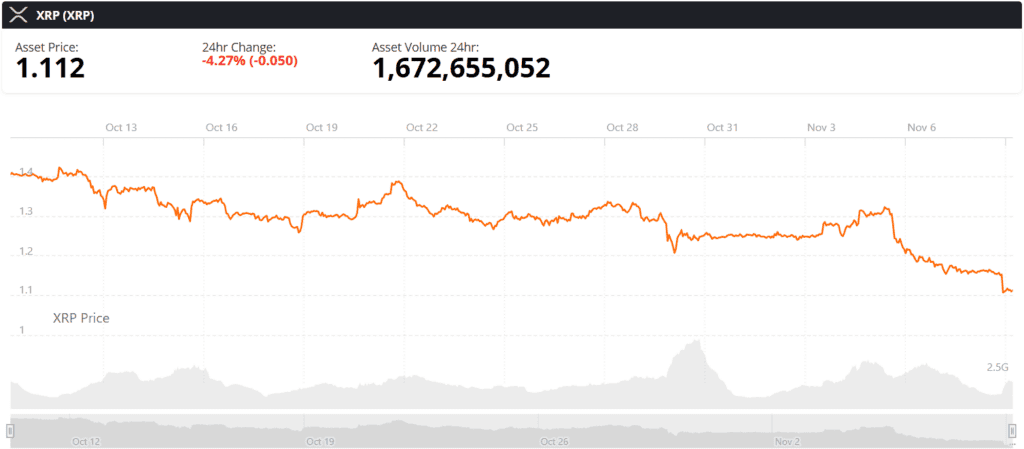
XRP worth chart. Supply: Brave New Coin
Schwartz has additionally addressed the rising variety of cryptocurrency-related messages showing beneath his posts about unrelated topics. He mentioned some accounts had used these conversations to accuse him of fraud, criticize Ripple, or promote XRP. In line with his rationalization, he started blocking accounts that repeatedly disrupted discussions, no matter whether or not their messages supported or criticized him.
His response got here amid broader questions concerning the relationship between Ripple’s technical progress, XRP Ledger adoption, and the token’s market efficiency. Nonetheless, developments in community infrastructure don’t routinely translate into fast worth appreciation. XRP continues to commerce in an open market the place investor demand, liquidity, wider cryptocurrency traits, and market sentiment affect its valuation.
Schwartz’s feedback due to this fact supply a distinction between his particular person affect and the broader forces governing XRP’s price. Whereas he acknowledged that his involvement is just not completely with out impact, he made clear that his potential to find out the token’s market efficiency is restricted.
Ahmed Ishtiaque Ahmed Ishtiaque Read More