
New Bitcoin Core advisories element three flaws fastened in 2025. The important thing questions are which nodes have been affected, which variations comprise fixes and what customers must know.
Bitcoin Core builders have disclosed three beforehand patched safety flaws, together with a Tor-related permissions mistake that affected 1000’s of reachable nodes and a high-severity bug that would cease an affected mining node from constructing blocks till restarted.
The rapid takeaway is sensible: operators must know which software program and configuration they run. The advisories describe weaknesses in node software program, not proof that Bitcoin’s provide guidelines failed or that non-public keys have been stolen.
Bitcoin Core Tor bug crossed a belief boundary
The Tor security advisory explains how incoming Tor connections might inherit permissions supposed for trusted computer systems. Tor site visitors reached Bitcoin Core by means of an area service. If an operator’s whitelist included that service’s handle, outdoors connections might obtain the identical exemptions as trusted native friends.
These permissions chill out some denial-of-service limits and privateness protections. The consequence was a mismatch between the operator’s supposed belief boundary and the connections truly receiving that belief.
The builders stated the configuration led to “1000’s of reachable mainnet nodes whitelisting all incoming Tor connections.” That describes affected deployments recognized within the disclosure; it isn’t a present census of nodes nonetheless operating weak software program.
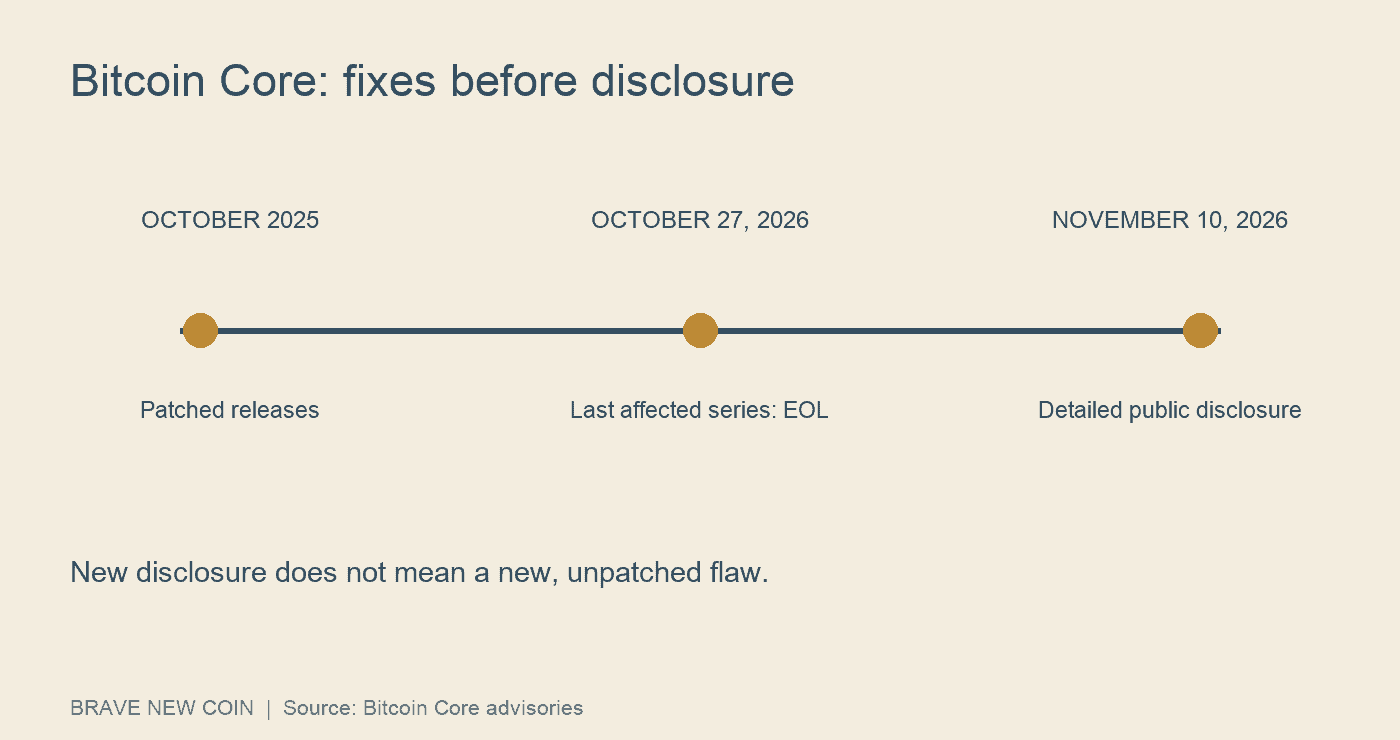
Nodes that by no means enabled the non-default whitelist setting weren’t affected by this difficulty. The advisory charges it medium severity and identifies fixes in Bitcoin Core 30.0, 29.2 and 28.3, launched in October 2025. The detailed public disclosure adopted on November 10, 2026.
A separate flaw might interrupt mining
The high-severity advisory considerations what occurs to pending transactions after a sequence reorganisation. A reorganisation happens when a node switches to a competing legitimate chain with extra collected work, and transactions from disconnected blocks might return to its pending pool.
Beneath explicit circumstances, affected software program might restore dependent transactions inconsistently. A mining node might then assemble a candidate block containing transactions whose required inputs have been lacking. Its personal validity checks would reject that candidate, stopping profitable block-template creation till a restart restored a constant pending pool.
This was a failure in an affected node’s means to arrange a block, not a mechanism for making the broader community settle for an invalid one. That distinction explains each the operational seriousness for a miner and the restrict of the disclosure’s implications for bizarre holders.
Bitcoin Core charges the problem excessive severity. The affected variations have been 28.0–28.2 and 29.0–29.1. The disclosure credit Niklas Goegge with discovering and responsibly reporting it in September 2025. It doesn’t report an assault exploiting the flaw.
The third advisory considerations delayed block processing
A third advisory describes a separate method a malicious peer might delay an affected node’s processing of latest blocks. Its severity is medium, and fixes have been launched in Bitcoin Core 29.2 and 30.0.
The priority is availability: a pc could also be operating however failing to maintain up with the community promptly. For a enterprise relying by itself node, that may complicate transaction monitoring and the well timed interpretation of confirmations even with out altering the possession of any cash.
The advisory identifies circumstances underneath which disruption may very well be repeated. Operators ought to comply with the builders’ revealed steering and use maintained software program, quite than assume {that a} seen connection to friends ensures the node is processing the most recent chain appropriately.
Why disclose bugs after fixes have been out there for a yr?
The timing follows Bitcoin Core’s disclosure policy. For medium- and high-severity points on the usual timetable, detailed disclosure usually comes two weeks after the final affected launch reaches finish of life. The November advisories determine October 27 as that milestone.
That method offers operators time to improve earlier than a fuller clarification turns into public. It additionally creates an necessary distinction for information readers: newly disclosed doesn’t essentially imply newly launched or newly fastened. On this case, the restore dates are in October 2025.
The coverage now makes a separate provision for simply discoverable vulnerabilities, together with flaws that may be discovered with minimal effort utilizing an AI mannequin. Such points can obtain a patched launch and advisory as quickly as doable. The three November 10 disclosures adopted the longer timetable.
What Bitcoin customers ought to take from the disclosures
For node operators, the related questions are model, configuration and operational dependencies. A package deal provided by one other vendor might bundle Bitcoin Core with extra software program and settings, so checking solely the identify of the applying is inadequate. The Tor difficulty reveals why default assumptions about trusted native connections deserve consideration.
For holders utilizing a hosted pockets or alternate, these advisories don’t instruct them to maneuver funds to a brand new handle. Their service supplier manages the underlying infrastructure. The suitable distinction is between infrastructure upkeep and a wallet-key compromise; the revealed flaws concern the previous.
The topic can be separate from the longer-term cryptographic dangers mentioned in BNC’s report on Bitcoin public-key exposure and quantum computing. A software program patch addresses a selected implementation weak spot. Planning for future quantum capabilities includes a special set of protocol and pockets selections.
The disclosures reinforce a well-recognized however consequential level: decentralised cash nonetheless depends upon well-maintained software program. Readers can take the bugs significantly with out mistaking them for proof that each Bitcoin node was affected, that funds have been stolen, or that the community stopped implementing legitimate blocks.
Jason Jones Jason Jones Read More