Will DePue’s evaluation claims hidden numerical patterns reveal Blackwell entry at DeepSeek and three different Chinese language labs, reopening questions on AI chip controls.
Researcher Will DePue says the numbers inside DeepSeek’s AI fashions carry a hidden Nvidia Blackwell fingerprint, elevating recent questions on Chinese language builders’ entry to restricted American computing {hardware}.
His declare spans six fashions from DeepSeek, Moonshot AI, MiniMax and Ant Group. The weird proof path is the fashions’ publicly launched weights: the large collections of numbers that decide how they work.
However the distinction between a hanging technical discovering and a confirmed export-control breach issues. The analysis identifies patterns left when fashions have been initialised. It can not, by itself, set up the place the {hardware} was positioned or how entry was obtained.
DeepSeek Blackwell declare turns mannequin weights into proof
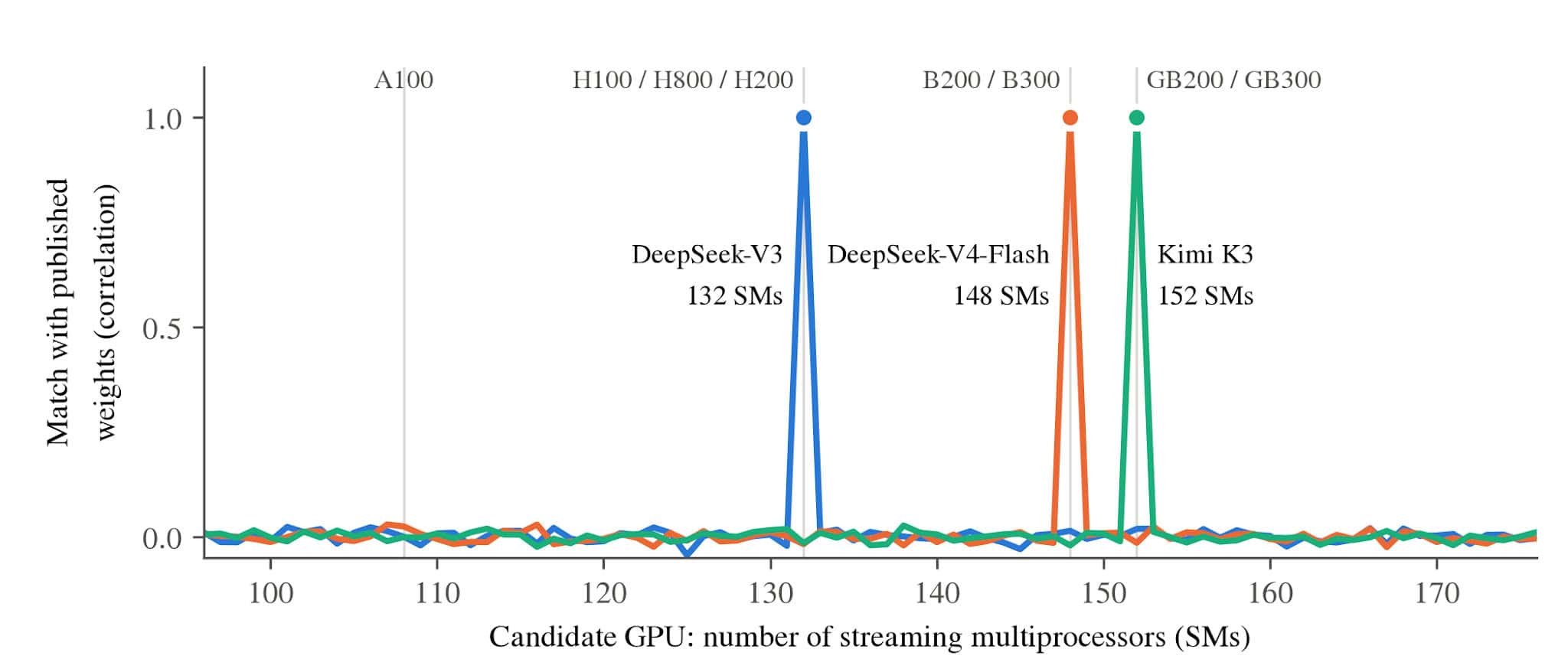
“This proof isn’t primarily based on any insider data or leaking,” DePue wrote in his post on X. He says he searched greater than six trillion combos of {hardware} format and random seed to seek out matches in revealed fashions.
The premise is that initialisation leaves a numerical hint. Earlier than coaching adjusts a mannequin’s weights, software program should generate their beginning values. DePue argues that how a GPU distributes that work can depart a recognisable sample that survives subsequent coaching.
In plain language, the declare is that the completed mannequin nonetheless incorporates clues in regards to the equipment that first set it up. That might make releasing weights a type of transparency extending past the mannequin’s capabilities to features of its manufacturing historical past.
What the {hardware} exams confirmed
DePue says a Blackwell B300 reproduced 445 whole preserved rows in DeepSeek-V4-Flash bit for bit, whereas a Hopper H100 didn’t. He additionally reviews reproducing Kimi K3’s sample on a rented GB200. These are his reported exams; BNC has not independently reproduced them.
DePue has additionally revealed a verification repository with chosen weight rows and scripts for 5 fashions, together with the older DeepSeek-V3. It lets readers replay these comparisons; releasing code just isn’t the identical as an unbiased replication.
The November 12 Unemployment Labs report associates DeepSeek-V4-Flash and MiniMax-M3 with B200/B300-compatible patterns. DeepSeek-V4-Professional, Kimi K3, Kimi K3.1-Professional and Ant Group’s Ling-3.1-flash match GB200/GB300-compatible layouts. The strategy doesn’t distinguish particular person chip fashions inside these teams.
There may be a longtime cause to care in regards to the actual surroundings in these comparisons. PyTorch’s reproducibility documentation explains that mounted seeds can reproduce random sequences underneath managed situations, whereas an identical seeds don’t assure an identical outcomes throughout platforms, variations or CPU and GPU execution.
That documentation doesn’t confirm DePue’s findings. It helps clarify why a convincing replica should specify the software program, {hardware} and settings, relatively than depend on an identical seed alone. The engineering particulars are a part of the proof, not incidental background.
The bounds are as essential because the fingerprint
An unusually configured AMD MI300X can mimic these layouts. The report excludes that different for V4-Flash, however not the opposite 5 fashions. Initialisation additionally needn’t use the {hardware} that subsequently trains a mannequin.
The report is specific that its findings “don’t set up the place the chips have been positioned, how entry was obtained, or whether or not export controls have been violated.” A {hardware} match due to this fact can’t be learn as a customs report or proof of a cargo into China.
These {qualifications} depart room for a consequential end result with out accepting each broader inference connected to it. Proof about one stage of mannequin growth might be invaluable even when the remainder of the availability chain stays unknown.
Why the export-control query is reside
The political context predates this report. In February, Reuters quoted a senior Trump administration official alleging that DeepSeek had educated a mannequin on Blackwell regardless of U.S. restrictions. The official didn’t disclose how the federal government obtained its data. That earlier allegation is context, not unbiased affirmation of DePue’s new exams.
The authorized framework additionally reaches past a easy map of chip areas. In May 31 guidance, the Bureau of Business and Safety stated pre-existing licensing necessities continued to use to lined advanced-computing gadgets destined for sure China- or Macau-headquartered entities, together with entities exterior these locations, until an relevant exception was obtainable.
That steerage issues specified transactions and controlled gadgets. Establishing a violation would require proof in regards to the events, permissions and circumstances concerned. A technical paper can elevate questions for investigators with out answering each authorized ingredient itself.
Operating DeepSeek on Blackwell is a distinct query
Nvidia’s own technical documentation already describes serving DeepSeek-V4 on Blackwell and Hopper programs. That’s inference: operating a launched mannequin to supply solutions. DePue’s evaluation issues the {hardware} used to generate beginning weights, with doable implications for coaching.
Complicated these levels would make extraordinary deployment documentation appear to be proof of the disputed growth course of. It’s not. An open mannequin can run on {hardware} totally different from the tools that initially created it.
For buyers, the broader concern is how {hardware} entry shapes AI competitors and the economics of supplying computing capability. BNC’s CoreWeave earnings analysis examined the financing burden behind that infrastructure buildout. This report provides a distinct query: how a lot outsiders can find out about computing entry from the fashions themselves.
The following helpful proof can be unbiased reproductions, scrutiny of other explanations and responses addressing the findings from the businesses named. For now, DePue has provided an in depth, testable declare. The intrigue lies in what the numbers would possibly reveal—and within the hole between figuring out a machine’s hint and reconstructing the way it got here for use.
Jason Jones Jason Jones Read More