The Commerce Division’s latest measures prolong present semiconductor controls to cloud infrastructure, including strain on Nvidia’s worldwide provide chain and escalating tensions between Washington and Beijing.
US Targets Distant Entry to Superior AI Chips
The US Division of Commerce’s Bureau of Trade and Safety (BIS) introduced an interim last rule on November 16, 2026, aimed toward stopping corporations in China and different restricted jurisdictions from accessing superior American computing know-how via abroad information facilities.
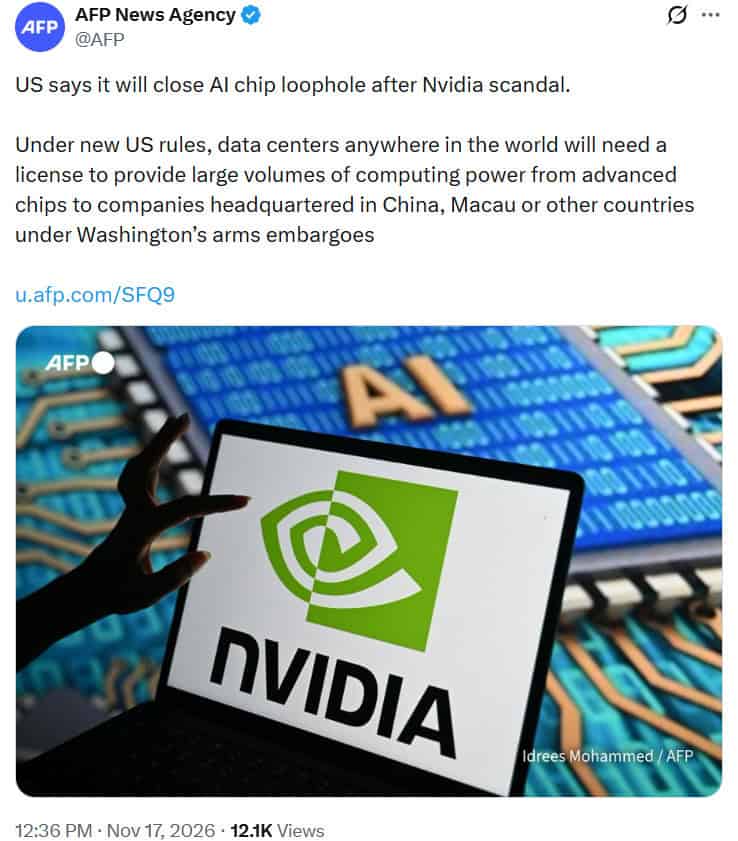
The US is tightening controls on distant entry to superior AI chips by Chinese language corporations via abroad information facilities. Supply: @AFP through X
Beforehand, US export controls primarily targeted on the bodily cargo of superior semiconductors. Nevertheless, corporations may probably bypass these restrictions by renting computing capability from information facilities working in international locations exterior the direct scope of the controls.
The brand new rule addresses this hole by requiring licenses for exports, reexports, or home transfers of coated superior semiconductors and associated tools meant for information facilities offering vital computing capability to corporations headquartered in China, Macau, or different designated restricted jurisdictions.
The regulation establishes a threshold of 12 million combination Whole Processing Efficiency (TPP) for computing entry throughout particular person or digitally linked information facilities. It additionally covers oblique preparations involving third-party operators and intermediaries.
Below the brand new necessities, information heart operators, overseas chip producers, and exporters should conduct buyer due diligence to determine the last word customers of superior computing infrastructure. This contains inspecting direct and oblique possession buildings to find out whether or not restricted entities management or profit from the companies.
The BIS mentioned the measure would guarantee present restrictions couldn’t be circumvented via distant computing preparations involving information facilities in third international locations.
5 Nations Face Extra Export Licensing Necessities
The US has additionally expanded its export licensing necessities to five countries recognized as higher-risk locations for semiconductor diversion.
The listing contains Singapore, Malaysia, Thailand, Indonesia, and Brazil. Corporations exporting, reexporting, or transferring coated superior semiconductors to those markets will face extra licensing necessities below the up to date framework.
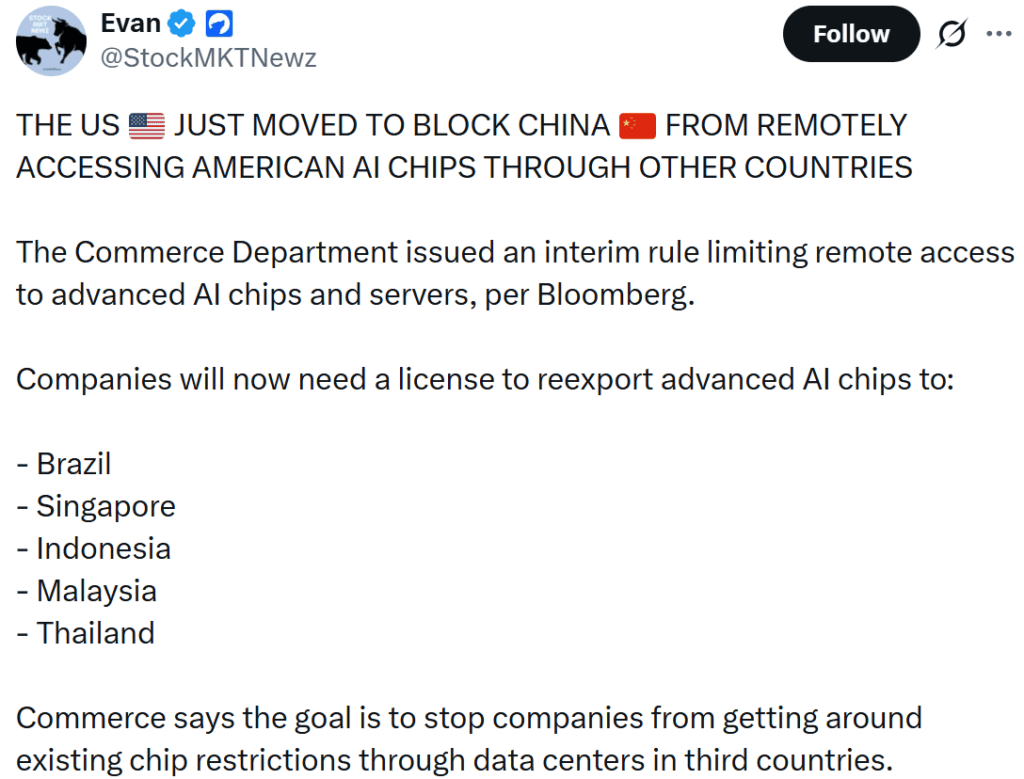
The US is tightening AI chip export controls, requiring licenses for transfers to high-risk international locations and setting a 12 million TPP computing threshold for information facilities serving restricted entities. Supply: @StockMKTNewz/X
The choice displays considerations that restricted chips may attain unauthorized locations via intermediaries, abroad cloud suppliers, or advanced supply-chain preparations.
Nevertheless, the principles embrace an exception for shipments meant for corporations headquartered in america or whose final mum or dad corporations are based mostly there, supplied exporters meet the relevant reporting necessities.
Current abroad information facilities that already present vital computing capability to restricted corporations could have 90 days from the rule’s efficient date to acquire the mandatory licenses in the event that they intend to proceed these companies.
The regulation additionally excludes industrial advice programs utilized by on-line retailers and social media platforms, supplied they meet the precise necessities. These programs usually rank, filter, or suggest merchandise and content material moderately than generate new AI fashions or content material.
The measures are a part of a broader effort to increase US export controls past bodily semiconductor shipments and canopy the computing infrastructure that permits superior AI improvement.
Megaspeed Investigation Provides Stress on Nvidia
The regulatory adjustments comply with rising scrutiny of Singapore-based cloud computing firm Megaspeed Worldwide, which has been investigated over suspected violations of US semiconductor export controls.
The US Commerce and Justice departments confirmed on November 16 that the investigation started in 2024 after authorities recognized suspicious exercise involving potential semiconductor diversion.
In response to their joint assertion, Commerce investigators requested data from Nvidia in Could 2025 regarding direct or oblique gross sales to Megaspeed. Nvidia subsequently positioned the corporate on its inside no-sell listing in June 2025.
US investigators, working alongside Singaporean legislation enforcement officers, performed an on-site inspection at Megaspeed that very same month and interviewed its then-chief govt, Alice Huang. The Justice Division later assumed the lead position within the prison investigation.
The case attracted extra consideration following reports about Alice Huang’s relationship with Nvidia co-founder Jensen Huang and allegations regarding her doable hyperlinks to Chinese language intelligence. These allegations haven’t been established as prison findings within the authorities’s public assertion.
Jensen Huang stepped down as Nvidia’s chief govt on November 12, 2026, amid rising scrutiny surrounding the controversy.
The investigation has highlighted how abroad cloud infrastructure can probably present entry to superior Nvidia processors with out requiring restricted chips to be bodily shipped into China.
The newest Commerce Division measures immediately tackle this sort of association by extending licensing necessities to information facilities that present computing capability to restricted prospects.
China Warns of Countermeasures as AI Commerce Tensions Escalate
Beijing has strongly opposed Washington’s newest export restrictions, warning that it may introduce countermeasures if america proceeds with the brand new controls.
China’s Commerce Ministry mentioned on November 17 that it firmly opposed the measure, arguing that it additional restricts Chinese language corporations’ entry to advanced AI chips from producers comparable to Nvidia.
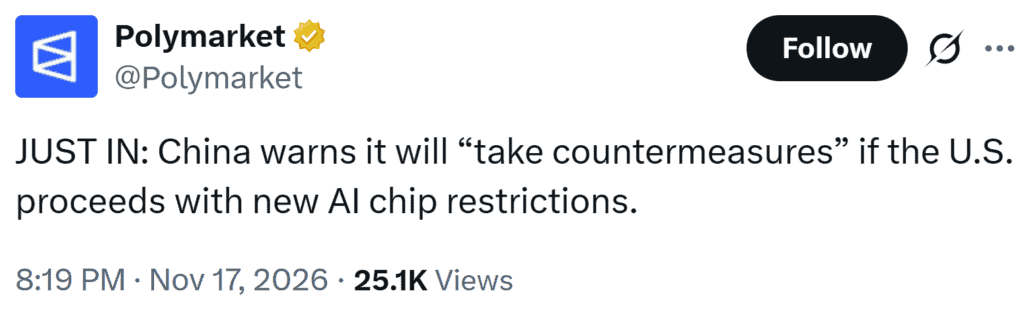
China warned it could take “obligatory measures” and retaliatory motion in response to the brand new US AI chip export restrictions. Supply: @Polymarket/X
The ministry additionally known as on Washington to return to the “right observe” of resolving variations via session and cooperation.
The response provides one other layer of rigidity to the know-how and commerce relationship between the world’s two largest economies. The announcement additionally comes forward of a deliberate assembly between US President Donald Trump and Chinese language President Xi Jinping on the APEC summit in Shenzhen.
In the meantime, US lawmakers are contemplating extra laws to strengthen oversight of superior semiconductor exports and tackle distant entry to restricted computing sources.
A number of proposals search to increase congressional oversight of chip export licenses and enhance monitoring mechanisms to stop superior processors from reaching unauthorized locations. These efforts may additional form US semiconductor coverage in 2027.
A Polymarket prediction market positioned the probability of a associated AI chip export licensing invoice turning into legislation in 2026 at 45%. The determine displays merchants’ expectations moderately than an official legislative forecast or confirmed final result.
Chinese language AI Shares Decline as Chip Entry Considerations Develop
The newest restrictions have additionally weighed on investor sentiment towards China’s synthetic intelligence sector.
Chinese language know-how shares declined on November 17 as buyers assessed the potential affect of tighter entry to superior computing infrastructure.
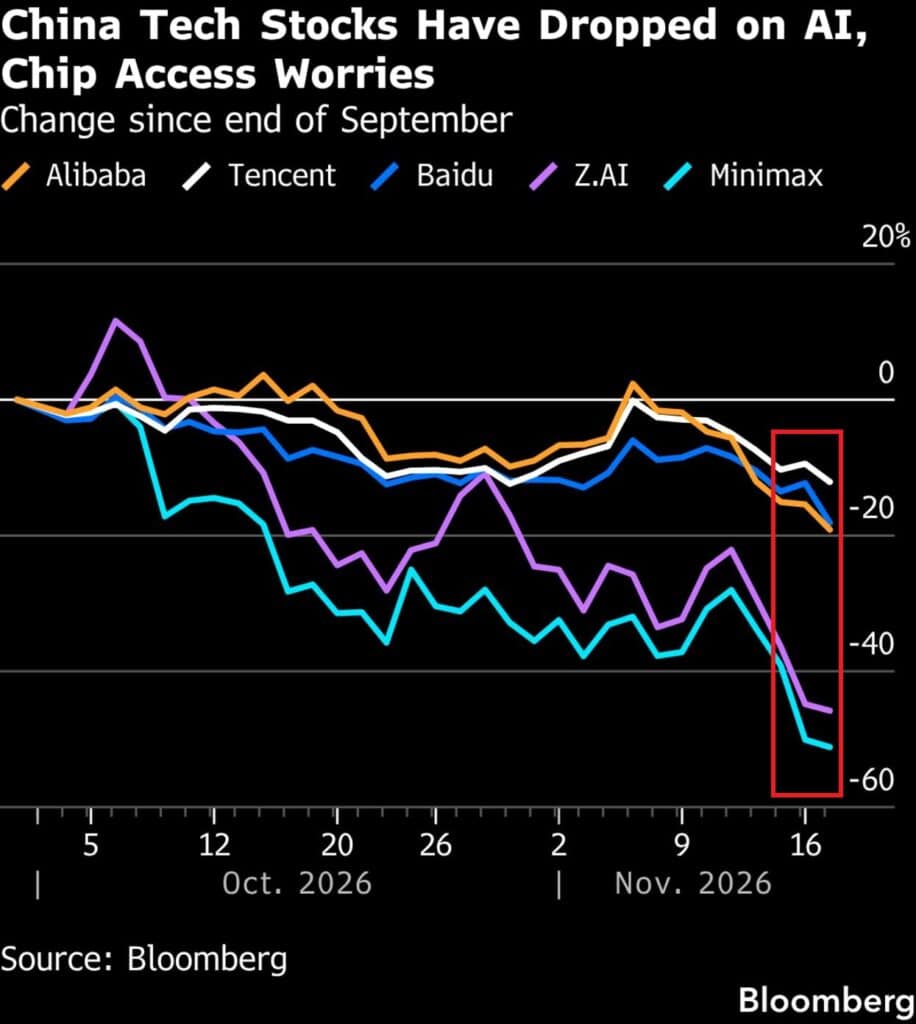
Bloomberg information exhibits mounting losses in main Chinese language tech shares, together with Alibaba, Tencent, and Baidu, accelerating in mid-November amid AI computing entry considerations. Supply: @GlobalMktObserv/X
Alibaba shares fell roughly 5%, whereas Baidu declined 5.8% to a document low. AI mannequin builders MiniMax and Z.AI additionally recorded losses exceeding 5%, whereas robotics firm Yushu Know-how dropped round 12%.
The declines contributed to a 1.1% fall within the Hold Seng Tech Index, reflecting considerations in regards to the potential affect of US semiconductor restrictions on Chinese language cloud suppliers and AI builders.
Nevertheless, the market response was not uniform throughout the semiconductor business. Chinese language chipmakers Semiconductor Manufacturing Worldwide Company (SMIC) and Hua Hong Semiconductor gained as buyers thought of the opportunity of elevated demand for domestically produced chips.
The divergence highlights the potential penalties of tighter US export controls for China’s technology industry. Whereas corporations depending on superior overseas processors may face increased computing prices and infrastructure constraints, home semiconductor producers could profit from efforts to scale back reliance on abroad suppliers.
The newest restrictions due to this fact prolong past Nvidia’s chip gross sales, probably affecting cloud computing suppliers, AI builders, semiconductor producers, and information heart operators throughout a number of markets.
For Nvidia, the regulatory adjustments introduce extra compliance necessities for worldwide prospects and distribution companions. For China, they create one other impediment in securing the computing sources wanted to develop more and more refined AI programs.
Ahmed Ishtiaque Ahmed Ishtiaque Read More