
Key takeaways
- The Fusionist ACE bridge exploit is estimated at $5.7 million throughout two levels, in response to SlowMist, which isn’t an audited remaining complete.
- About $1.87 million in proceeds was traced to the attacker, whereas 53.7 million real ACE tokens, valued close to $3.7 million, have been reportedly withdrawn by the bridge.
- Bithumb halted ACE buying and selling on November 23 after discovering indicators that abnormally issued ACE had entered exchanges.
- Within the materials reviewed, Fusionist has not printed a reconciled loss determine or a technical autopsy.
The Fusionist ACE bridge exploit has produced an estimated $5.7 million in losses throughout two levels, in response to SlowMist’s incident tracker. After unbacked ACE tokens have been minted on BNB Chain and offered, merchants reportedly used the ensuing worth collapse to withdraw actual ACE from the mission’s Endurance bridge reserves. The fallout reached centralized exchanges on Monday, November 23: Bithumb halted ACE trading after discovering indications that abnormally issued tokens had entered crypto exchanges.
This was not one attacker strolling away with $5.7 million in a single transaction. The excellence issues. Roughly $1.87 million was traced by the attacker’s proceeds, whereas one other 53.7 million real ACE tokens, valued round $3.7 million on the incident’s reference costs, have been reportedly withdrawn by the bridge. SlowMist lists a mixed $5.7 million loss estimate, not an audited remaining complete. The bridge’s most simple promise, {that a} token issued on one chain corresponds to one thing actual on one other, is exactly what now wants proving.
A Privileged Minter Printed Tokens That Had No Backing
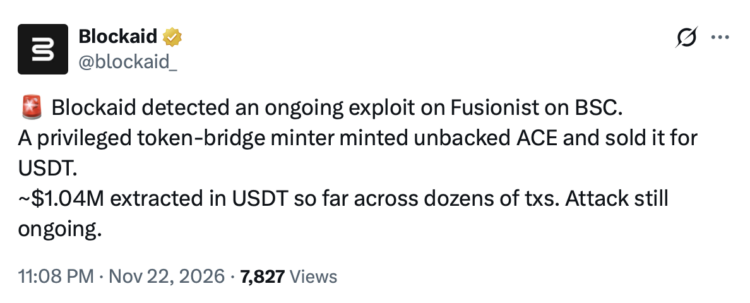
Safety agency Blockaid flagged the Fusionist bridge-minter exploit on November 22. Its alert described the mechanism bluntly:
“
A privileged token-bridge minter minted unbacked ACE and offered it for USDT.
The agency initially estimated that about $1.04 million had been extracted whereas the assault was nonetheless ongoing. That was an interim snapshot, not a cap on the harm.
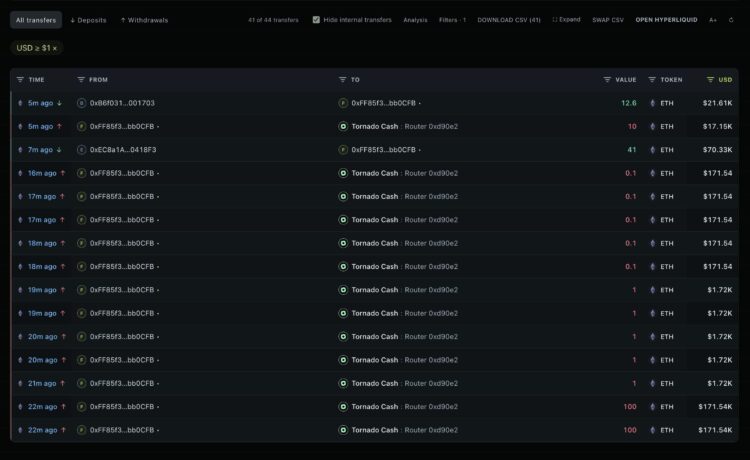
Blockchain-monitoring account Onchain Lens subsequently reported that an attacker had routed 1,091.5 ETH, valued at about $1.87 million on the time, by Twister Money. That statement traces a motion of proceeds, not an additional $1.87 million so as to add on prime of the preliminary extraction estimate. The values describe totally different factors in the identical suspected attacker’s fund circulate.
Fusionist acknowledged an obvious ongoing ACE exploit on BNB Smart Chain on Sunday and requested customers to droop transfers, buying and selling and bridging on that community. It has not, within the materials reviewed, supplied a reconciled loss determine or a technical autopsy figuring out how the privileged minting authority was abused.
A bridge minter is meant to create a token illustration solely when the corresponding worth is correctly accounted for. As soon as the precise to mint is misused, a sequence can present completely ordinary-looking balances that don’t have any matching backing.
It’s a acquainted failure mode: NewsBTC beforehand coated a bridge-role exploit that minted unbacked tokens at CrediX. That earlier case doesn’t set up Fusionist’s root trigger, nevertheless it illustrates why elevated bridge permissions are such a consequential safety boundary.
Merchants Discovered a Second Exit By means of Actual ACE Reserves
The next drain might show extra essential than the preliminary minting spree.
In line with SlowMist’s November 22 incident entry, merchants purchased the sharply discounted ACE created by the market disruption and used the cross-chain bridge to withdraw about 53.7 million real ACE from the Endurance-side reserves. SlowMist valued that withdrawal at roughly $3.7 million.
Right here is the mechanism with out the jargon. A illustration of ACE on BNB Chain immediately turned low-cost as a result of unauthorized provide had flooded the market. A bridge that might nonetheless settle for these tokens in trade for ACE on Endurance supplied an apparent distinction in worth.
Anybody in a position to full that conversion might obtain actual tokens in return for deeply discounted ones. The buying and selling alternative existed as a result of the backing and the circulating illustration have been now not in a reliable relationship.
The $3.7 million determine is a valuation of the ACE reserve outflow, not proof that each recipient offered these tokens for $3.7 million in money. Nor does it imply each dealer concerned helped compromise the minter.
There’s a significant distinction between initiating the safety breach and buying and selling by a system whose defenses have already failed.
These distinctions mustn’t obscure the core drawback. A bridge can have technically legitimate transactions and nonetheless produce an economically disastrous end result. If unbacked provide will be redeemed for real reserves, the checks have failed the place they matter most.
Bithumb’s Monday Halt Exhibits How Far the Downside Travelled
Bithumb suspended ACE deposits and withdrawals early on November 23. It then halted buying and selling efficient 7:30 a.m. Korea time, in response to its follow-up ACE security notice.
The trade stated, in a translation from its Korean announcement, that it had:
“
confirmed indications that abnormally issued ACE had entered cryptocurrency exchanges.
It recognized two associated BNB Chain transactions and a second transaction.
These data are essential proof leads, however a full impartial decoding of the transaction path stays excellent.
Bithumb’s wording is cautious: it reported indicators of irregular provide coming into exchanges, not a discovering that each ACE token in buyer accounts is invalid. The buying and selling suspension is a protecting response, not a finalized dedication of buyer losses.
Nonetheless, it creates a sensible drawback for holders who by no means used the bridge. If tokens are fungible inside a market, exchanges and the issuer want a reputable technique for figuring out affected provide and deciding how deposits, balances and trades might be handled.
The Actual Safety Query Is Why the Bridge Might Honor the Claims
There’s an comprehensible temptation to concentrate on the big minting figures. The extra consequential query is what occurred when these tokens met the bridge’s reserves.
A system doesn’t have to lose management of its complete blockchain to undergo a severe failure in a single privileged contract position. Nor ought to a successful-looking bridge transaction rely as proof that the asset being transferred was absolutely backed.
Our evaluation
The response can’t finish with a pause discover and a promise to analyze.
Fusionist wants to indicate which minting permissions have been affected, whether or not they have been revoked, how a lot ACE was created with out backing, how the Endurance-side reserve modified and what claims stay excellent.
Exchanges want a defensible token-treatment plan, and holders have to know whether or not there’s a shortfall and who’s chargeable for masking it.
There’s a truthful counterargument: the $5.7 million determine is an exterior estimate, market costs moved throughout the incident, and the exact compromise technique will not be established.
SlowMist categorizes the incident as private-key leakage, however that classification will not be an alternative choice to an official technical discovering. It could even be untimely to deal with a cautious trade halt as proof that each affected buyer suffered a loss.
These {qualifications} change how the numbers needs to be reported. They don’t make the underlying bridge-accounting failure much less severe.
The following credible milestone will not be a restored interface or a reassuring social submit. It’s a clear reconciliation of the tokens minted, the reserves withdrawn and the belongings nonetheless accessible to again respectable ACE claims.
Till that exists, the estimated $5.7 million fallout stays a warning about each token safety and the dangers of trusting a bridge’s accounting.
Disclaimer: this text is for informational functions solely and isn’t monetary recommendation.
Tomás Rivas Read More