Key takeaways
- Vitalik Buterin’s November 26 essay argues that crypto safety should prolong to the bodily chips inside gadgets, summed up as “Not your silicon, not your keys.”
- He needs producers to publish bodily chip layouts (GDS information) so investigators can examine actual {hardware} towards the design.
- Researcher Andrew Huang’s infrared inspection method (IRIS) can look at chips with out eradicating them, but it surely has decision limits and isn’t a common repair.
- The essay is a proposal, not a declare that present {hardware} wallets are compromised, and publishing it doesn’t give Buterin energy to vary Ethereum unilaterally.
- Arkham attributes about $390 million in belongings to Buterin, principally roughly 224,000 ETH, although his true internet value will not be publicly established.
Who’s Vitalik Buterin, and why is Ethereum’s co-founder now questioning the safety of the very gadgets crypto buyers use to guard their wealth? The 32-year-old programmer has turned his consideration to an issue that even open-source software program can’t essentially remedy: compromised laptop chips.
In an essay revealed on November 26, Buterin argued that cryptocurrency security needs to extend beyond software and into the bodily {hardware} on which it runs. His message builds on considered one of crypto’s oldest ideas, however with a brand new twist:
“
Not your silicon, not your keys.
Vitalik Buterin · Essay, November 26
For somebody who helped construct a substitute for centralized monetary infrastructure, questioning the producers behind that infrastructure looks as if a pure subsequent step.
It additionally displays a safety philosophy that has change into more and more seen in Buterin’s work, from his push for greater privacy and quantum safety on Ethereum’s roadmap to his curiosity in independently verifiable computing.
Who Is Vitalik Buterin?
Vitalik Buterin is a Russian-Canadian programmer, researcher and author who conceived Ethereum in 2013, on the age of 19.
Born in Russia in 1994 and raised in Canada, Buterin found Bitcoin in 2011. He went on to co-found Bitcoin Journal, the place he explored the know-how and economics behind cryptocurrencies lengthy earlier than digital belongings attracted mainstream monetary establishments.
His involvement in Bitcoin uncovered him to an issue that will ultimately result in Ethereum. Blockchain know-how had potential past transferring cash, however constructing extra subtle purposes on Bitcoin introduced technical limitations.
Relatively than making an attempt to accommodate each attainable software inside Bitcoin’s present structure, Buterin started engaged on a blockchain designed particularly for programmability.
On the time, he was learning laptop science on the College of Waterloo, the place he additionally labored as a analysis assistant to cryptographer Ian Goldberg.
In accordance with the College of Waterloo, Buterin received a $100,000 Thiel Fellowship in 2014 and subsequently left college to work on Ethereum full-time.
How Vitalik Buterin Created Ethereum
In November 2013, Buterin wrote the preliminary draft of what would change into the Ethereum whitepaper.
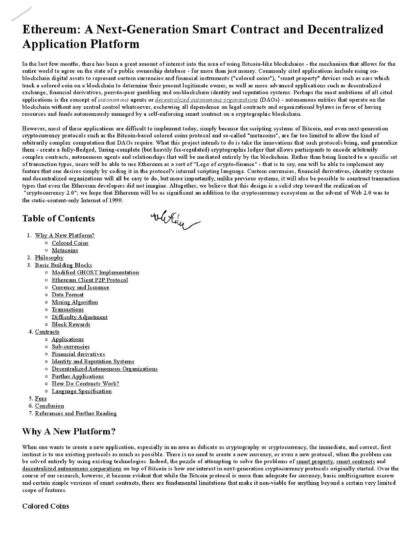
The proposal described a blockchain with a general-purpose programming atmosphere. Builders would now not have to create a completely new community each time they needed to construct a decentralized software.
Take into account a lending platform. As a substitute of counting on a financial institution to handle collateral, calculate curiosity and authorize withdrawals, builders may encode these guidelines into good contracts working on Ethereum.
That doesn’t get rid of each danger. Sensible contracts can comprise bugs, depend upon unreliable exterior knowledge or function below centralized administrative controls. What Ethereum launched was the flexibility to execute monetary and different programmable agreements on a shared blockchain.
Though Buterin originated the idea, Ethereum was not constructed by him alone. Its founding staff included seven different people: Gavin Wooden, Joseph Lubin, Charles Hoskinson, Anthony Di Iorio, Mihai Alisie, Jeffrey Wilcke and Amir Chetrit.
The mission’s first stay community, often called Frontier, launched on July 30, 2015.
What started as an experimental computing platform ultimately grew to become the inspiration for a lot of the decentralized finance business. Stablecoins, decentralized exchanges, lending protocols and tokenized monetary belongings now use the infrastructure that Buterin and Ethereum’s early contributors helped set up.
The community’s personal evolution, significantly its transition to proof-of-stake and the event of Layer 2 scaling networks, has formed Ethereum’s first decade.
Vitalik Buterin’s Newest Warning: Can Crypto Wallets Actually Be Trusted?
A {hardware} pockets is meant to maintain personal keys away from probably compromised computer systems and smartphones. However what occurs if the system itself can’t be trusted?
Buterin’s newest analysis examines that risk. He factors to provide chain assaults involving tampered wallets and considers the potential for malicious modifications hid inside apparently reputable chips.
Open-source firmware permits researchers to look at the directions a tool runs. However these directions reveal little about whether or not the manufactured chip has been altered.
Buterin needs producers to reveal bodily chip layouts, often called GDS information, so investigators have a reference towards which to examine precise {hardware}.
The excellence issues. Realizing what a chip is designed to do will not be essentially the identical as realizing what the chip inside your pockets really does.
The Know-how That Might Assist Detect Compromised Chips
One method highlighted by Buterin comes from {hardware} safety researcher Andrew Huang, higher often called bunnie.
Huang has been creating a way known as Infra-Red, In Situ inspection (IRIS), which exploits the truth that silicon turns into clear at sure infrared wavelengths.
Utilizing infrared illumination and appropriate imaging tools, researchers can look at elements of a chip’s inside construction with out essentially eradicating it from its circuit board.
The method may assist detect substituted elements or sudden variations between manufactured chips and their meant designs.
Nevertheless, it isn’t a common resolution.
In a 2024 replace on his analysis, Huang explained that infrared imaging has resolution limits. It can’t reliably reveal each microscopic characteristic of recent chips. Combining imaging with extra electrical testing may enhance confidence in a element’s integrity.
That is a crucial limitation for crypto buyers. Publishing an open {hardware} design doesn’t routinely make a pockets safe, simply as publishing a sensible contract’s code doesn’t set up that it is freed from vulnerabilities.
Buterin acknowledges that subtle {hardware} inspections usually tend to be carried out by specialist organizations than bizarre pockets house owners.
His essay is a proposal for bettering safety, not an announcement that present {hardware} wallets have all been compromised.
Does Vitalik Buterin Management Ethereum?
Regardless of his standing as Ethereum’s most recognizable co-founder, Buterin will not be its CEO.
Ethereum is maintained by way of the participation of unbiased builders, researchers, node operators, validators and different ecosystem contributors. Modifications to the community contain technical proposals, dialogue, software program improvement and adoption by individuals.
Buterin has appreciable affect over these discussions, however publishing a proposal doesn’t give him the authority to implement it unilaterally.
His position inside the Ethereum Basis can be distinct from management over the blockchain itself. In its April 2025 governance announcement, the Basis described Buterin’s tasks as offering technical and mental steering to the broader ecosystem.
His analysis can affect the path Ethereum takes. Whether or not the community finally follows that path will depend on significantly greater than his endorsement.
How A lot Is Vitalik Buterin Price?
Buterin collected appreciable wealth by way of his involvement in Ethereum, with a lot of his publicly seen cryptocurrency wealth tied to ETH.
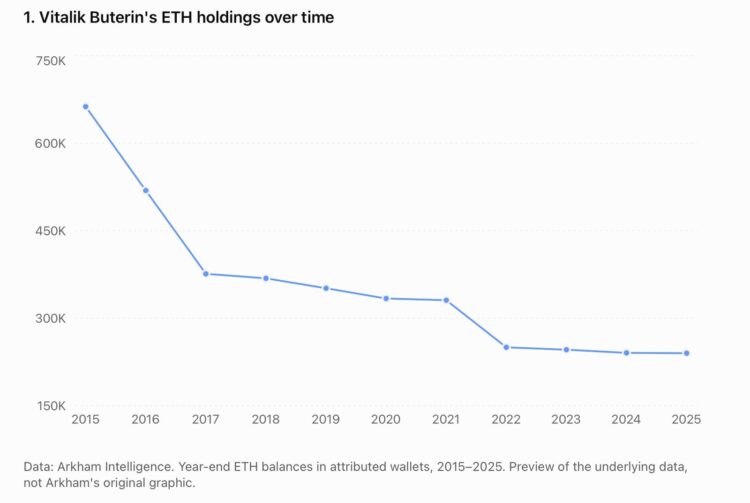
Nevertheless, his precise internet value will not be publicly established.
Blockchain analytics can estimate the worth of belongings held in wallets attributed to him, however these figures don’t essentially account for all his investments, liabilities, personal belongings or holdings at addresses that haven’t been publicly recognized.
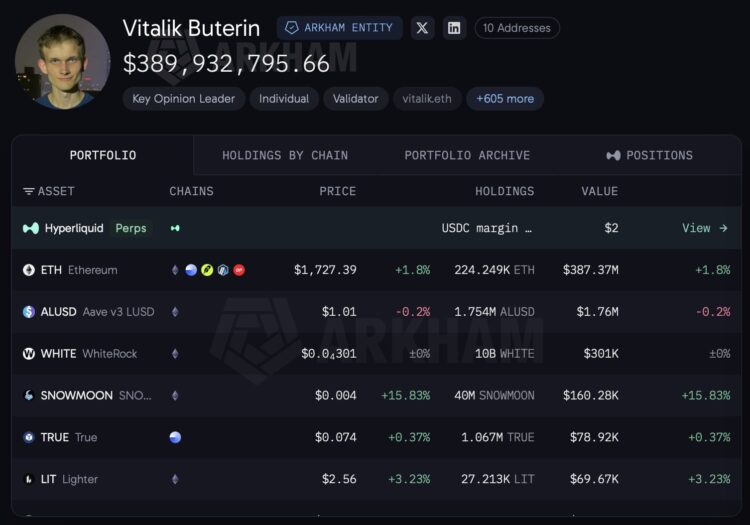
In addition they fluctuate with cryptocurrency costs. A pockets valuation ought to due to this fact not be confused with a whole evaluation of his private wealth.
What Is Vitalik Buterin’s Imaginative and prescient for the Way forward for Crypto?
Buterin’s newest essay is a part of a longer-running curiosity in making digital infrastructure independently verifiable.
In September 2025, he revealed The Importance of Full-Stack Openness and Verifiability, exploring how transparency may prolong throughout the {hardware} and software program underpinning more and more necessary elements of individuals’s lives.
His broader analysis contains cryptography, privateness, blockchain scalability and Ethereum’s transition towards larger quantum resistance. Buterin has beforehand known as for greater experimentation across Ethereum’s application layer with out compromising its core ideas of censorship resistance, open-source improvement, privateness and safety.
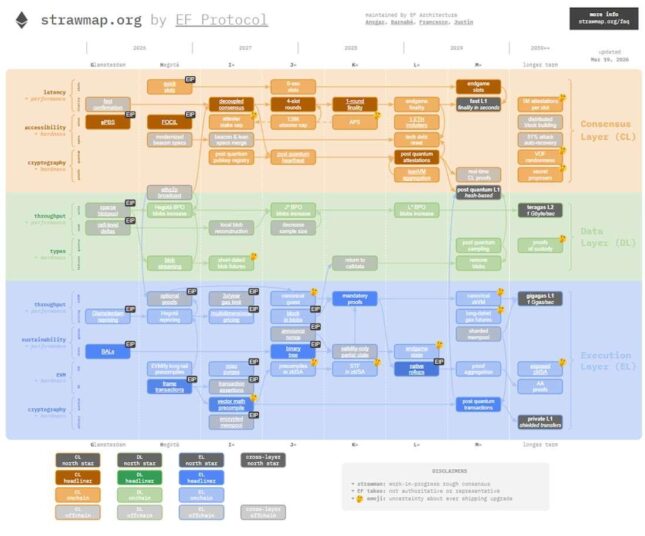
These pursuits share a sensible concern: whether or not customers can independently set up that the techniques they depend on behave as meant.
There’s a business impediment, although. Semiconductor producers make investments closely in proprietary processes, and designing chips particularly for inspectability can contain efficiency compromises.
However a tool signing a cryptocurrency transaction doesn’t essentially want the computing energy of a contemporary AI processor. That makes security-focused {hardware} a probably helpful place to begin.
Greater than a decade in the past, Buterin challenged the concept blockchains ought to primarily be used to switch cash. His newest work challenges one other assumption the business has grown comfy with: that trusting the code is sufficient.
For crypto buyers, the subsequent significant improvement could come from {hardware} producers prepared to make their merchandise independently inspectable, slightly than one other software program replace promising larger safety.
Tomás Rivas Read More