
The brand new workflow combines AI-powered code evaluation with brokers that handle developer suggestions, resolve failing checks, and decide whether or not adjustments meet a group’s approval necessities.
Claude Ship (beta) automates PR opinions, fixes points, and approves adjustments underneath group insurance policies to speed up code supply. Supply: @ClaudeDevs/X
The release targets a rising bottleneck in software program growth as AI coding instruments generate code quicker than engineering groups can manually evaluate and approve it.
How Claude Ship Handles GitHub Pull Requests
Claude Ship brings collectively three parts: Code Assessment, PR Steward, and Claude Approvals. The system is designed to deal with completely different levels of the pull request (PR) course of, from figuring out potential bugs to resolving points and figuring out which adjustments are eligible for approval.
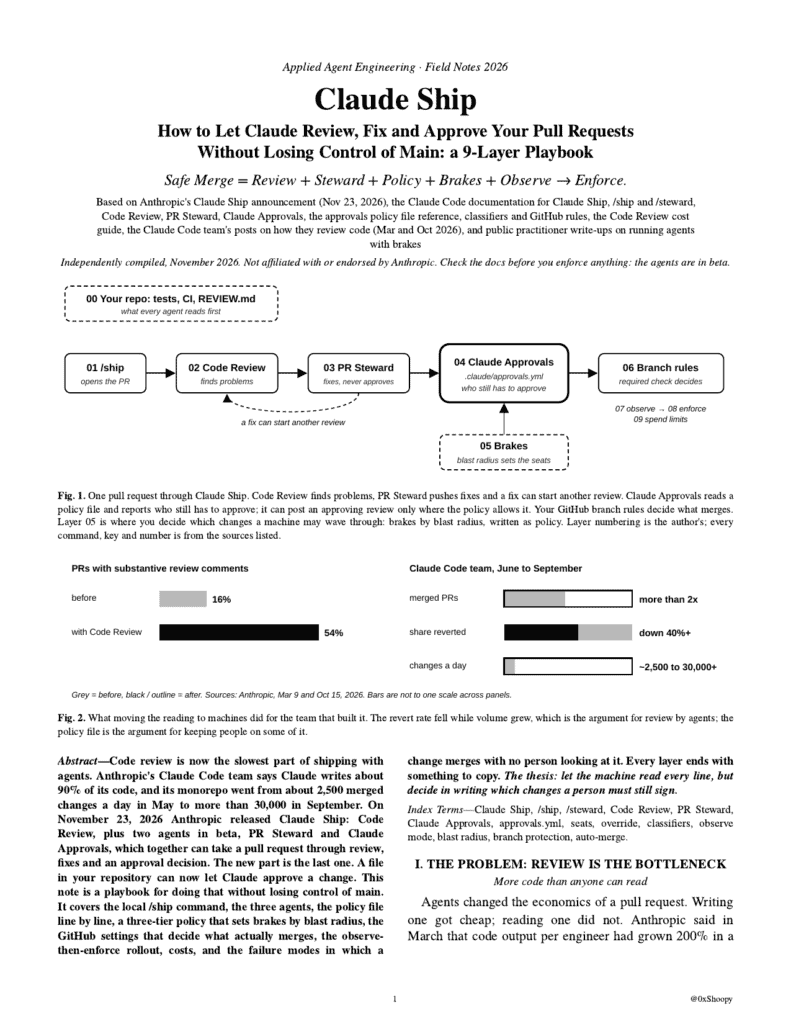
The Claude Ship workflow combines automated fixes, policy-based approvals, threat checks, and gradual enforcement to guard the principle department. Supply: @0xShoopy/X
Code Assessment, which is already usually obtainable, examines proposed adjustments towards the broader codebase. It makes use of a number of AI brokers to determine potential issues, confirm findings, and categorize points earlier than posting them to GitHub. Groups can choose Fast, Normal or Deep evaluate ranges relying on the complexity of their initiatives and the extent of scrutiny required.
PR Steward takes over when a pull request receives suggestions or encounters issues. The agent works within the cloud to handle feedback from builders, resolve merge conflicts, and repair failing steady integration (CI) checks. It might additionally reply to findings from Code Assessment and different evaluate instruments. After every push, PR Steward explains what it modified and supplies directions for reversing these adjustments if needed.
Anthropic has separated these tasks from the approval course of. PR Steward is designed to repair issues with out approving or merging pull requests. Claude Approvals handles that call by way of insurance policies established by the event group.
Builders also can direct the agent by way of GitHub feedback. For instance, they’ll use @claude to offer further directions or @claude cease to pause its exercise.
Staff Insurance policies Decide Which Modifications Claude Can Approve
Claude Approvals introduces an automatic sign-off course of based mostly on guidelines maintained inside a repository. Anthropic describes the strategy as just like a extra superior CODEOWNERS file, permitting engineering groups to outline approval necessities past fundamental file possession.
The coverage can decide which adjustments qualify for automated approval and which require human involvement. Groups can use customized classifiers written in pure language, contemplate Code Assessment findings, and specify how many individuals should approve explicit adjustments. Delicate code can stay topic to necessary human sign-off, even when routine updates qualify for automated approval.
Anthropic recommends initially operating Claude Approvals in observe-only mode. Throughout this part, the agent evaluates pull requests and studies its choices with out granting approvals. Groups can examine these choices with their current evaluate course of earlier than enabling enforcement.
GitHub department safety and required checks stay a part of the method. Repository permissions and established guidelines proceed to manipulate what may be merged, serving to organizations introduce AI-assisted approvals with out eradicating their current controls.
Anthropic Studies Quicker Code Evaluations and Extra Merged PRs
Claude Ship builds on Anthropic’s inner expertise utilizing AI brokers to evaluate code written by each builders and different AI methods. The corporate has more and more relied on Claude for its personal software program growth, making a must deal with code opinions at an analogous tempo.
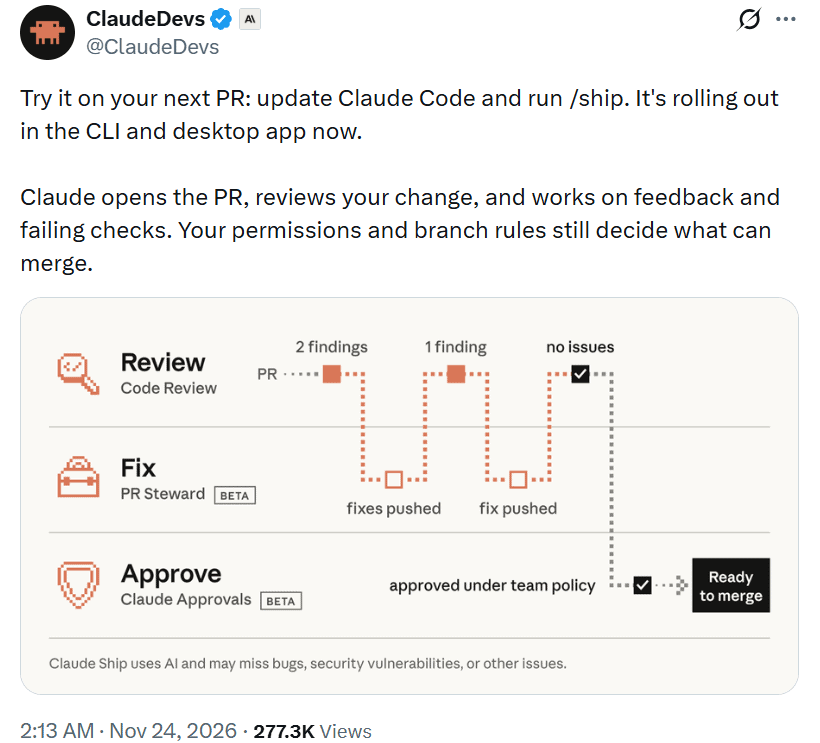
Now obtainable for GitHub repositories on Claude Staff and Enterprise, with admin-controlled repo-wide automation. Supply: @ClaudeDevs/X
In an October engineering weblog put up, Anthropic mentioned merged pull requests for the Claude Code codebase greater than doubled between June and September 2026. The corporate additionally reported that the share of merged adjustments that required reverts fell by greater than 40% throughout that interval.
The figures mirror Claude’s position in a wider inner evaluate course of fairly than the efficiency of Claude Ship as an independently examined product. Anthropic additionally beforehand reported a rise within the share of inner pull requests receiving substantive evaluate feedback, from 16% to 54%, following the introduction of its Code Assessment system.
These outcomes point out how automated evaluation can improve evaluate protection whereas decreasing a number of the work required from engineering groups. Nonetheless, the figures are based mostly on Anthropic’s personal growth setting and shouldn’t be interpreted as independently verified efficiency benchmarks for different organizations.
Human Oversight Stays A part of the Workflow
Anthropic’s engineering group has described a layered strategy to reviewing AI-generated code. The inner course of contains testing adjustments earlier than a pull request opens, automated code and safety opinions, CI checks, risk-based human approvals, merge queues, and mechanisms for detecting and reversing defective releases.
The corporate distinguishes between routine updates and adjustments that would create wider technical or safety issues. Documentation adjustments and low-risk updates could require fewer human approvals, whereas delicate areas equivalent to billing methods, software program replace mechanisms and CI workflows obtain further scrutiny. Anthropic additionally makes use of monitoring and rollback procedures as a result of automated opinions can not eradicate each potential error.
Buyer suggestions highlighted the supposed division of tasks. Vatsal Bhatt, Director of Engineering at TELUS Digital, mentioned: “We hold a human within the loop, and the human’s time now goes to the adjustments that want it.”
The strategy displays Anthropic’s place that AI ought to tackle repetitive evaluate and correction duties whereas builders retain duty for choices that require deeper technical judgment. The corporate additionally acknowledges that Claude Ship could miss bugs, safety vulnerabilities, or different issues.
Availability and How Builders Can Use Claude Ship
Claude Ship is out there in beta to clients on Claude Staff and Enterprise plans utilizing GitHub repositories. Code Assessment is usually obtainable, whereas PR Steward and Claude Approvals stay in beta.
Particular person builders can entry the workflow by way of Claude Code by updating the appliance and operating the /ship command on a ready change. Claude then pushes the change, opens a pull request, opinions it, and works by way of suggestions and failing checks. The command is rolling out by way of the Claude Code CLI and desktop software.
Engineering directors can allow the system throughout particular person repositories with out requiring builders to invoke /ship manually. They will select evaluate ranges, decide when automated opinions run, and set up month-to-month spending limits. Organizations also can introduce the parts individually fairly than activating the whole workflow instantly.
Claude Ship makes use of token-based billing, with prices relying on pull request quantity, code dimension, evaluate depth, and the quantity of labor carried out by PR Steward. Anthropic additionally lists restrictions for organizations utilizing Zero Information Retention, HIPAA configurations, or customer-managed encryption keys.
With Claude Ship, Anthropic is extending AI-assisted software growth into the evaluate and approval levels that historically rely upon engineering groups. Its strategy offers organizations extra choices for dealing with routine adjustments routinely whereas preserving human oversight for choices that require further scrutiny.
Ahmed Ishtiaque Ahmed Ishtiaque Read More