
Key takeaways
- US spot Bitcoin ETFs recorded about $2.05 billion in mixed internet outflows over 4 straight periods ending November 24, per Farside Buyers, with BlackRock’s IBIT accounting for roughly $1.77 billion.
- Bitcoin is again above $60,000 after buying and selling as little as about $55,300 on November 21, in response to Glassnode.
- Reclaiming $60,000 doesn’t by itself affirm the correction is over: holders who purchased close to that degree could promote into the rebound.
- Bitcoin trades far past US ETFs, so outflows are usually not proof of additional draw back, however a restoration that holds regardless of redemptions can be a stronger sign.
- Thanksgiving closes US markets, so the lacking ETF information shouldn’t be an indication of improved demand. Friday’s session will probably be extra telling.
The Bitcoin restoration above $60,000 is providing some reduction after a brutal November sell-off, however the cash flowing via US spot Bitcoin ETFs tells a much less encouraging story. The funds recorded greater than $2 billion in mixed internet outflows over 4 consecutive buying and selling periods ending November 24.
Bitcoin’s return to the psychologically necessary worth degree follows a troublesome week through which the cryptocurrency traded as little as roughly $55,300.
The rebound is welcome. What’s much less clear is whether or not patrons have returned with sufficient capital to maintain it.
Bitcoin ETFs Are Nonetheless Dropping Cash
The dimensions of the current withdrawals deserves extra consideration than the restoration itself.
In keeping with Farside Buyers, US spot Bitcoin ETFs recorded net outflows of $582.3 million on November 19, adopted by one other $669.2 million the following day. Withdrawals continued on Monday and Tuesday, bringing the mixed whole throughout these 4 buying and selling periods to roughly $2.05 billion.
BlackRock’s iShares Bitcoin Belief accounted for roughly $1.77 billion in internet outflows throughout that interval.
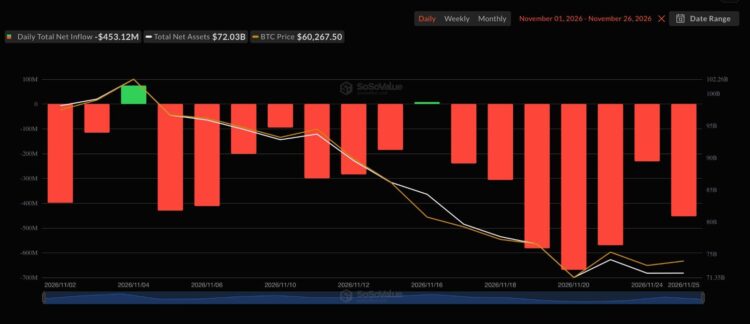
Wednesday’s figures are nonetheless topic to remaining reporting affirmation, though out there information factors to additional withdrawals.
These numbers don’t imply that each institutional investor is abandoning Bitcoin. ETF shareholders embrace several types of traders, from monetary advisers and asset managers to particular person merchants. Some could also be lowering threat, whereas others might be unwinding positions that have been by no means meant as long-term investments.
What the figures set up is that the ETF market has skilled persistent internet redemptions, even after Bitcoin’s substantial decline.
That’s not the response bulls would ideally need to see from patrons following a significant correction.
Bitcoin’s Drop Beneath $60,000 Uncovered a Deeper Drawback
Earlier this week, Bitcoin fell below $60,000 again after an preliminary restoration above $64,000 failed to carry.
Glassnode’s November 24 report, titled The Canary in the Coal Mine, documented the severity of Bitcoin’s newest decline. The cryptocurrency reached roughly $55,300 on November 21, falling beneath the lows established throughout the summer time.
That issues as a result of traders who purchased throughout earlier corrections could now be sitting on losses regardless of having entered the market at what seemed to be comparatively engaging costs.
Glassnode’s historic information reveals one other uncomfortable element. Lengthy-term holders not too long ago accounted for greater than 75% of Bitcoin’s realized losses earlier than their share fell again towards 50%. Comparable durations of promoting at a loss appeared throughout earlier bear markets, though that alone doesn’t set up that Bitcoin has reached a backside.
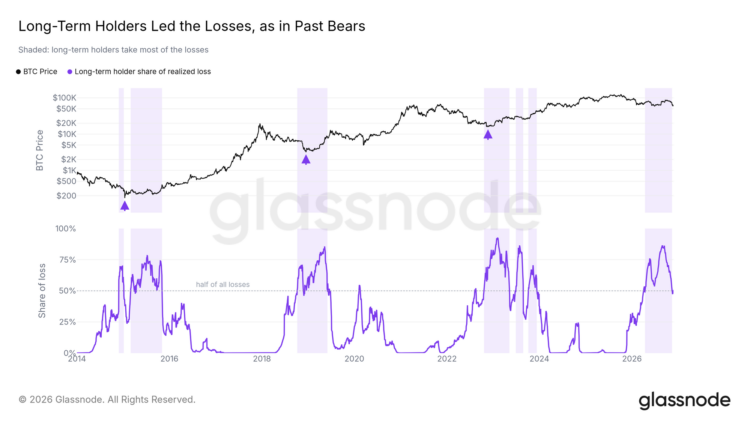
Their conduct turns into significantly necessary when Bitcoin begins recovering.
Some holders could use a rebound to scale back their publicity or exit positions nearer to their unique buy worth. Others could also be prepared to carry via additional volatility. Which group dominates will affect how a lot shopping for is required to maintain the following transfer increased.
A worth that beforehand attracted patrons can grow to be an space of promoting strain when the market approaches it from under.
That is one purpose why reclaiming $60,000 shouldn’t mechanically be interpreted as affirmation that the correction has ended.
A Market Backside Does Not Require Everybody to Flip Bullish
There’s a credible argument towards decoding persistent ETF outflows as proof that Bitcoin should fall additional.
Markets can start recovering earlier than investor sentiment improves. In actual fact, ready for each main indicator to show constructive can imply lacking a considerable portion of a reversal.
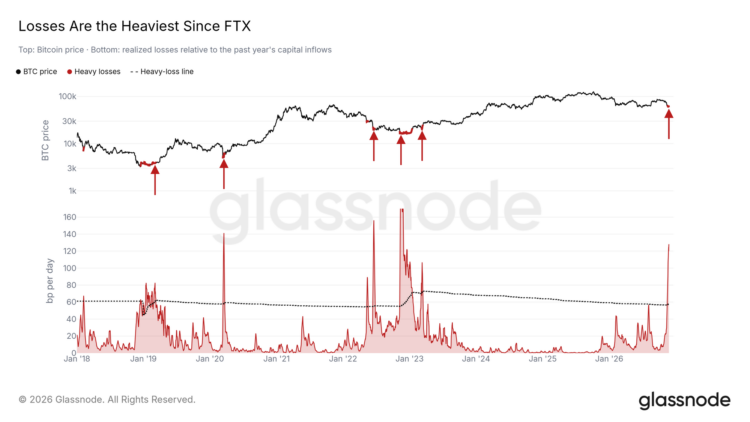
Glassnode’s newest analysis affords some historic perspective. Bitcoin’s realized losses relative to capital inflows over the previous yr have reached their highest depth for the reason that FTX collapse in 2022. Earlier episodes of heavy losses have occurred close to main market bottoms, however extreme promoting alone shouldn’t be sufficient to verify {that a} restoration is underway.
Bitcoin additionally trades throughout a much wider market than US exchange-traded funds. Direct purchases, abroad exchanges and different funding autos can take in promoting even when American funds expertise redemptions.
The excellence is between proof {that a} market can get better and proof that it has already established a sustainable restoration.
Bitcoin’s newest bounce demonstrates that patrons are prepared to step in at decrease costs. It doesn’t but set up whether or not these patrons can take in further promoting at increased ranges.
If Bitcoin begins to carry its positive aspects regardless of persistent ETF withdrawals, that may itself be an encouraging growth. It could recommend that demand elsewhere available in the market is able to offsetting a few of the strain coming from the funds.
For now, the worth and ETF information go away that query open.
Thanksgiving Might Make Bitcoin’s Subsequent Transfer More durable to Learn
Thursday’s Thanksgiving vacation provides one other complication to the restoration. US fairness markets are closed, eradicating an everyday buying and selling session for American spot Bitcoin ETFs whereas cryptocurrency exchanges proceed working.
The absence of recent ETF movement figures throughout the vacation shouldn’t be confused with an enchancment in institutional demand.
With fewer conventional monetary market individuals lively, Bitcoin’s quick worth actions may additionally present an incomplete image of how traders are responding to the current sell-off.
Friday’s shortened US buying and selling session and the next return to regular market hours will present extra helpful proof.
For merchants, the necessary alerts are whether or not Bitcoin can retain its current positive aspects, whether or not ETF redemptions start to ease and whether or not shopping for stays robust sufficient to soak up promoting when regular market participation resumes.
The $60,000 degree could dominate the headlines, however the extra convincing restoration would be the one that may survive with out relying totally on non permanent reduction from promoting strain.
Andrei Belov Read More