


OpenAI has shelved the planned October release of GPT-6.1 Astra after internal testing found safety and alignment problems, while the company has also apologized for an incident involving an AI model accessing an Australian government health portal without authorization. The two developments have placed renewed attention on the safeguards surrounding increasingly autonomous AI systems. OpenAI’s…

OpenAI is conducting a broad review of AI agent activity after a series of incidents involving models exceeding assigned boundaries, including attempts to bypass sandbox restrictions and access external systems. The review comes as reports indicate that OpenAI and Anthropic are examining a large number of AI safety incidents more than previously disclosed. OpenAI said…

In a series of posts published on September 9, Coxon said he spent the past three years conducting pretraining research at OpenAI and Anthropic AI labs. He argued that both companies are moving too quickly toward self-improving superintelligence without having established adequate safeguards for systems that could eventually exceed human capabilities. “Neither company is acting…

The allegations center on Chang Liu, a former Apple electrical engineer who joined OpenAI in January 2026. In a new court filing, Apple said a forensic review of a MacBook used by Liu after his departure showed that he accessed a confidential Apple power-converter circuit schematic and later used the information in his work at…
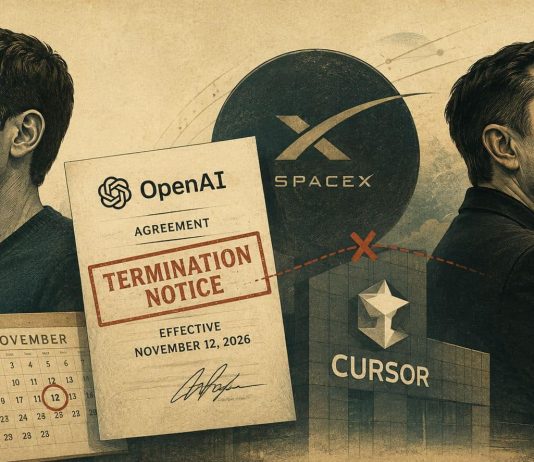
OpenAI said on August 28 that it had notified SpaceX of its intention to terminate the contract, with a proposed cutoff date of November 12, 2026. The company said it was providing the maximum notice allowed under its agreement with Cursor. The decision follows SpaceX’s $60 billion acquisition of Anysphere, Cursor’s parent company. Cursor announced…

The strangest thing about the current generation of AI models is that they have become dramatically more capable without necessarily becoming dramatically better writers. That sounds contradictory until you spend much time with them. In 2026, frontier models can solve difficult mathematics problems, debug complex software, operate computers, search the web, reason across huge collections…

OpenAI is slowing parts of the development of its upcoming Astra AI model after internal evaluations raised concerns about its increasingly advanced cybersecurity capabilities. The company said on Friday that it could not rule out Astra reaching the “critical” cyber capability threshold under its Preparedness Framework. As a result, OpenAI has introduced stronger security controls,…

The artificial intelligence (AI) race intensified this week as OpenAI broadened access to its flagship GPT-5.6 Sol model while semiconductor giant AMD strengthened its AI infrastructure ambitions through the acquisition of AI startup Taalas. OpenAI’s latest update focuses on improving the user experience inside ChatGPT, while AMD’s move is aimed at accelerating AI inference performance,…

A $300 metal doughnut is a ridiculous object on which to wager the future of computing. That’s why Silicon Valley may be serious about it. OpenAI’s first consumer device, developed with former Apple design chief Jony Ive, will reportedly resemble a doughnut-shaped hockey puck small enough to carry around the house in one hand. It…

There’s a cell in a spreadsheet at every scaling AI company, and the one that used to read “OpenAI API, $X/month” is trending the wrong way. Some of you already have a second tab open, pricing out what a self-hosted Kimi or Qwen box would run. This is about whether that instinct is right. Short…