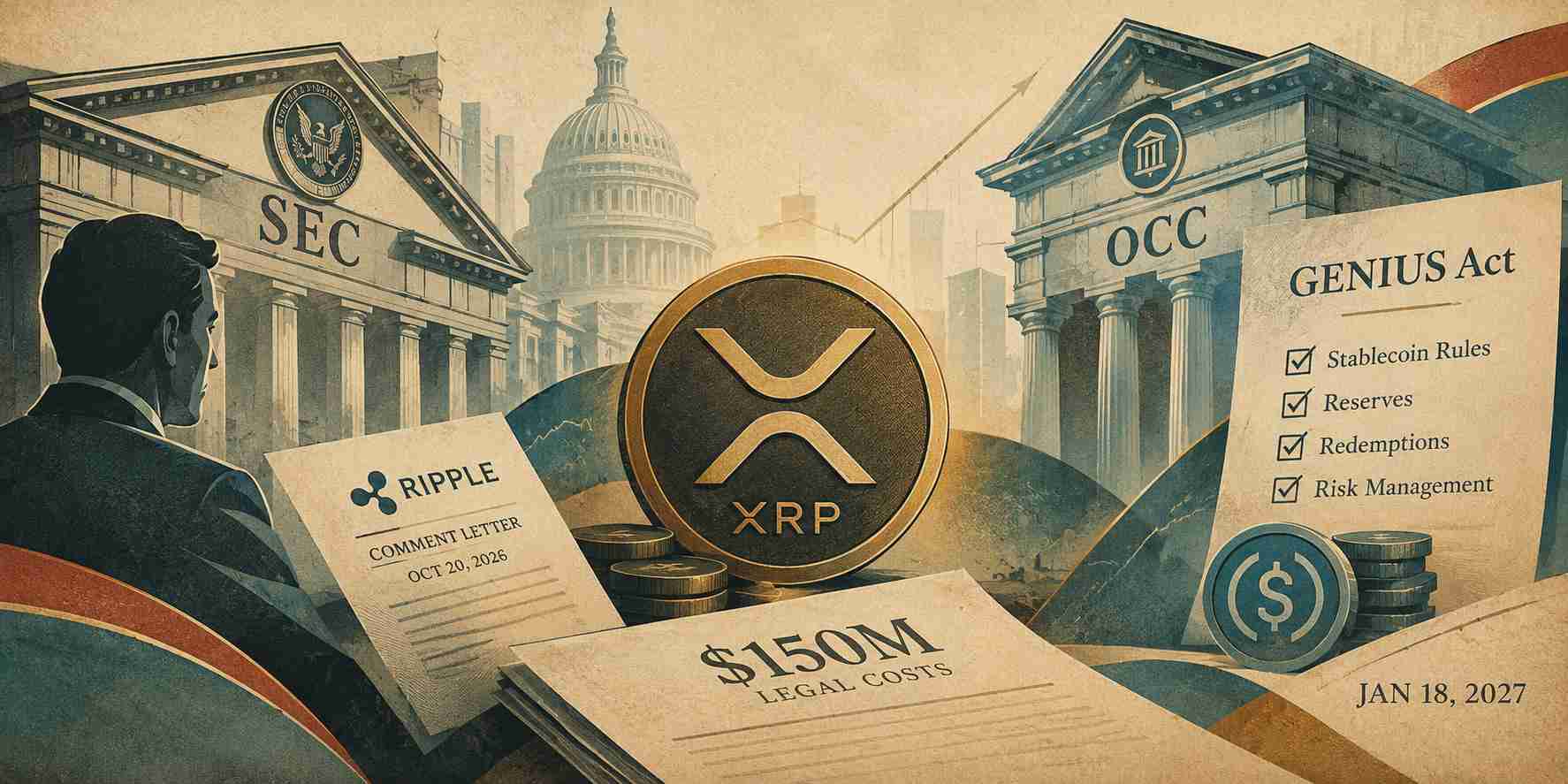
In an October 20 comment letter, Ripple supported the proposed framework whereas requesting modifications to how federal securities regulation treats digital property, funding contracts, and secondary-market transactions.
The event coincides with the Workplace of the Comptroller of the Forex (OCC) finalizing guidelines beneath the GENIUS Act, establishing federal requirements for cost stablecoin issuers. Though the initiatives deal with totally different components of the crypto trade, each might form how digital asset companies function in the USA.
Key takeaways
- Ripple backed the SEC’s proposed Regulation Crypto Belongings on October 20 whereas in search of revisions to provisions affecting token gross sales and funding contracts.
- Ripple Chief Authorized Officer Stuart Alderoty cited greater than $150 million in litigation prices, highlighting the monetary burden of regulatory uncertainty.
- The OCC finalized its GENIUS Act rule in October 2026, setting necessities for stablecoin reserves, redemptions, capital, and danger administration.
- The SEC proposal stays topic to rulemaking, whereas the OCC framework is scheduled to take impact on January 18, 2027.
Ripple Helps SEC Proposal After $150 Million Authorized Combat
Ripple submitted its remark letter on October 20, the ultimate day of the general public remark interval for the SEC’s proposed Regulation Crypto Belongings. Launched on August 18, the proposal seeks to ascertain a tailor-made framework for sure funding contracts involving cryptocurrencies.
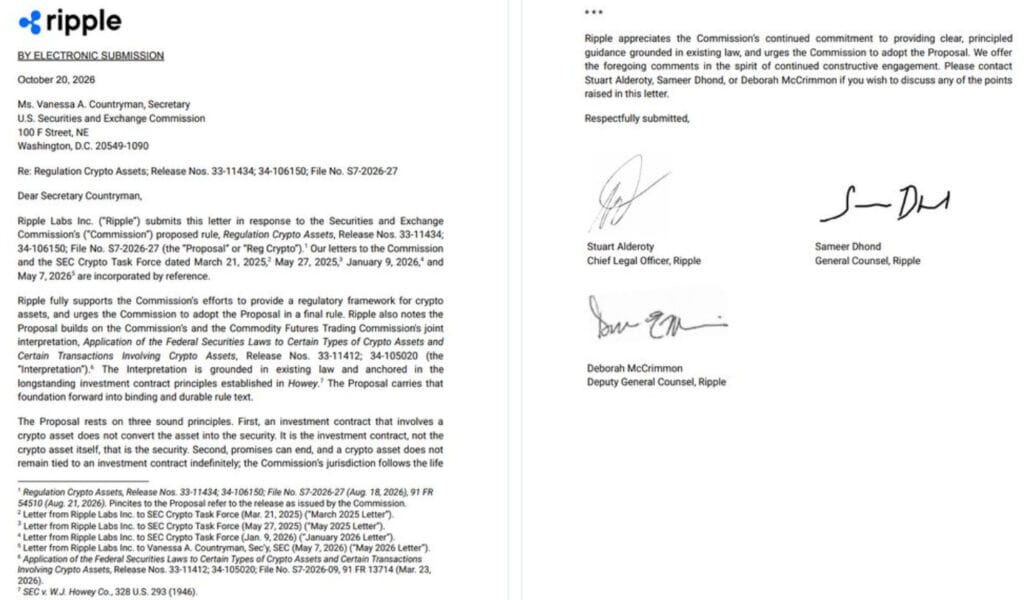
Ripple’s authorized staff urged the SEC to tell apart crypto property from funding contracts beneath the Howey check and change case-by-case enforcement with clear regulatory requirements. Supply: @RippleXity by way of X
The corporate’s assist marks a notable improvement following its years-long dispute with the SEC over XRP gross sales. Ripple is backing the company’s effort to ascertain clearer guidelines however desires modifications to make sure that securities regulation applies in line with the phrases of a specific funding association, somewhat than mechanically attaching to the underlying token.
Alderoty has argued that enforcement-driven regulation imposed substantial prices on the trade and pushed innovation abroad. Ripple’s reported $150 million in authorized bills illustrates the size of its dispute with the company.
The SEC proposal consists of potential registration exemptions for qualifying choices of as much as $5 million over 4 years or $75 million inside a 12-month interval. Eligible issuers would stay topic to relevant disclosure necessities and federal anti-fraud protections.
It additionally proposes a conditional protected harbor addressing when an funding contract related to a crypto asset could stop to qualify as a safety. These provisions should not but closing, and their eventual scope will depend upon the SEC’s consideration of public feedback and its rulemaking authority.
Why Ripple Needs Clearer Guidelines for XRP Transactions
Ripple’s central concern is the appliance of the Howey check, the authorized framework used to find out whether or not a transaction or association qualifies as an funding contract beneath U.S. securities regulation.
The corporate argues that an funding contract involving a digital asset mustn’t mechanically make the token itself a safety in each subsequent transaction. It desires the SEC to concentrate on the guarantees made to buyers, the obligations assumed by the issuer, and the circumstances beneath which these obligations could finish.
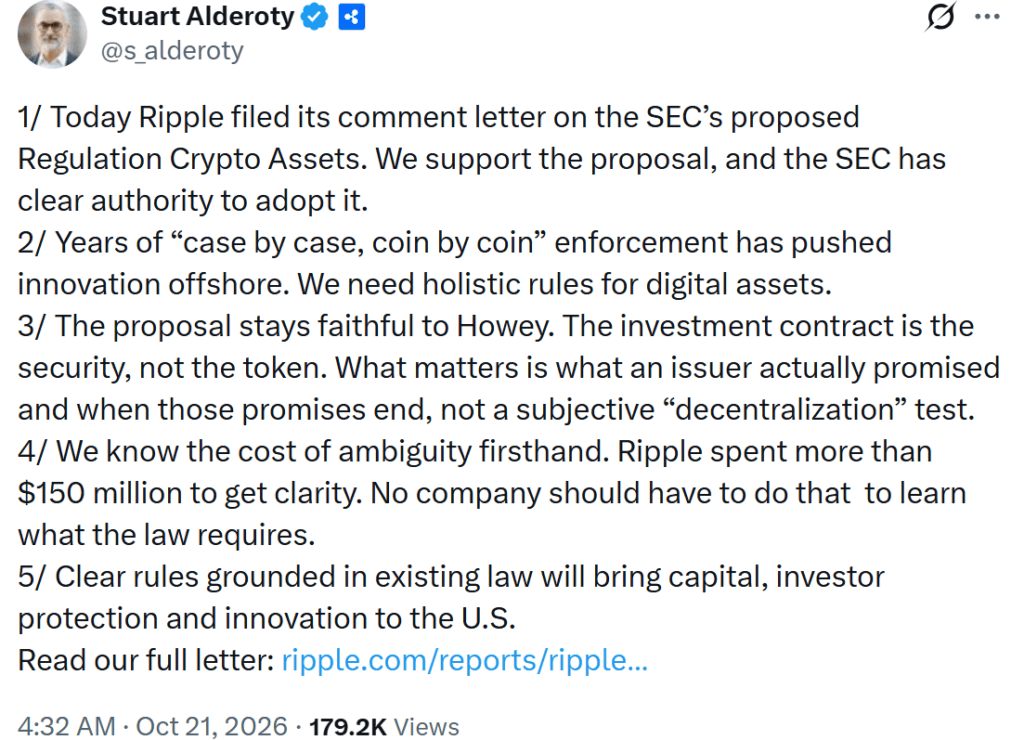
The publish criticizes enforcement-driven regulation for pushing crypto innovation abroad and urges clear, Howey-based guidelines that distinguish funding contracts from the underlying tokens. Supply: Stuart Alderoty by way of X
The problem featured prominently in Ripple’s authorized dispute with the company. In 2023, a federal courtroom distinguished Ripple’s institutional XRP gross sales from sure programmatic gross sales on public exchanges. The ruling didn’t set up a blanket exemption for each XRP transaction.
The case reached a resolution in 2025, however questions on token classification and secondary-market transactions stay related to different cryptocurrency tasks.
Ripple additionally challenges the usage of decentralization because the decisive measure for figuring out when investment-contract obligations finish. As a substitute, it favors requirements primarily based on the particular commitments and duties related to an providing.
The corporate’s place displays a sensible concern for crypto companies: they should perceive which authorized obligations apply when issuing tokens and when these property subsequently change arms. The ultimate SEC guidelines, if adopted, might assist set up extra constant standards.
Ripple’s $150 million determine refers to its reported authorized prices, not the separate $125 million civil penalty related to the case. The 2 quantities signify totally different features of the dispute.
What the SEC Proposal Might Imply for XRP
Ripple’s submitting locations XRP inside a wider debate over how U.S. regulators ought to classify digital property. Nonetheless, supporting the SEC proposal doesn’t change XRP’s authorized standing or assure that the company will settle for Ripple’s requested revisions.
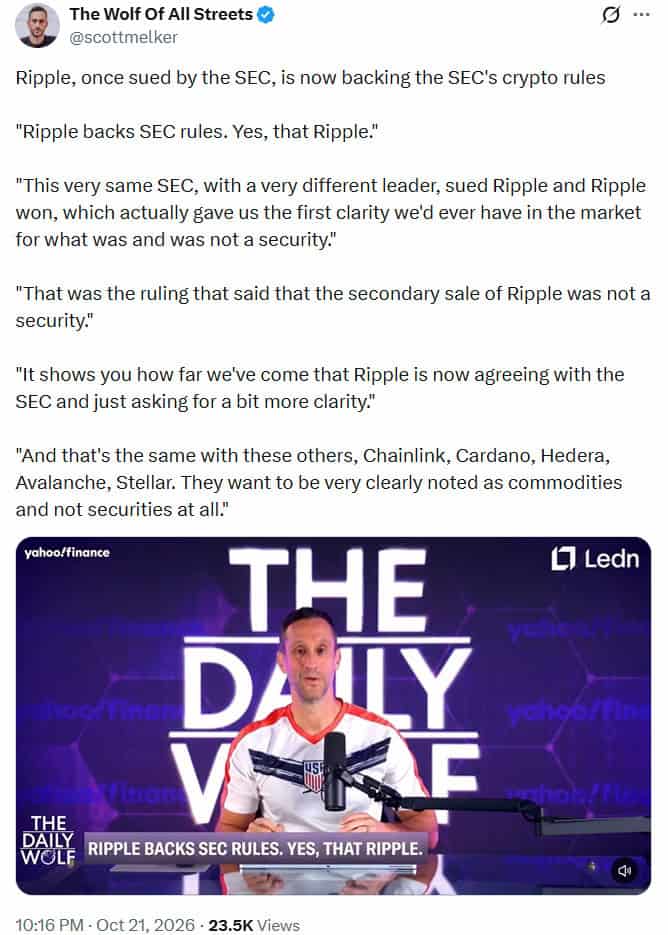
Ripple’s assist for the SEC’s proposed crypto guidelines marks a shift after years of litigation, following a 2023 courtroom ruling that sure public-exchange XRP gross sales weren’t securities transactions. Supply: The Wolf Of All Streets by way of X
If adopted with significant clarification, the principles might assist companies assess whether or not specific token choices qualify for exemptions and when related investment-contract obligations apply. Their impression would depend upon the ultimate textual content, eligibility situations, and therapy of present preparations.
Different cryptocurrency tasks, together with Chainlink, Cardano, Hedera, Avalanche, and Stellar, have additionally referred to as for better certainty round token classification and the respective roles of the SEC and the Commodity Futures Buying and selling Fee.
The talk has intensified amid setbacks for broader cryptocurrency market-structure laws in Congress. SEC rulemaking supplies one other path to establishing detailed necessities, though it can’t resolve each challenge which will require congressional motion.
For XRP holders, the important thing improvement to observe is the ultimate therapy of funding contracts and secondary-market transactions. Ripple’s remark letter is an try and affect these guidelines, not a assure of a specific end result for XRP.
OCC Finalizes GENIUS Act Guidelines for Fee Stablecoins
Individually, the OCC finalized its rule implementing the Guiding and Establishing Nationwide Innovation for U.S. Stablecoins (GENIUS) Act in October 2026. Signed into regulation by President Donald Trump in July 2025, the laws establishes a federal framework for cost stablecoins and customarily restricts U.S. issuance to permitted issuers.
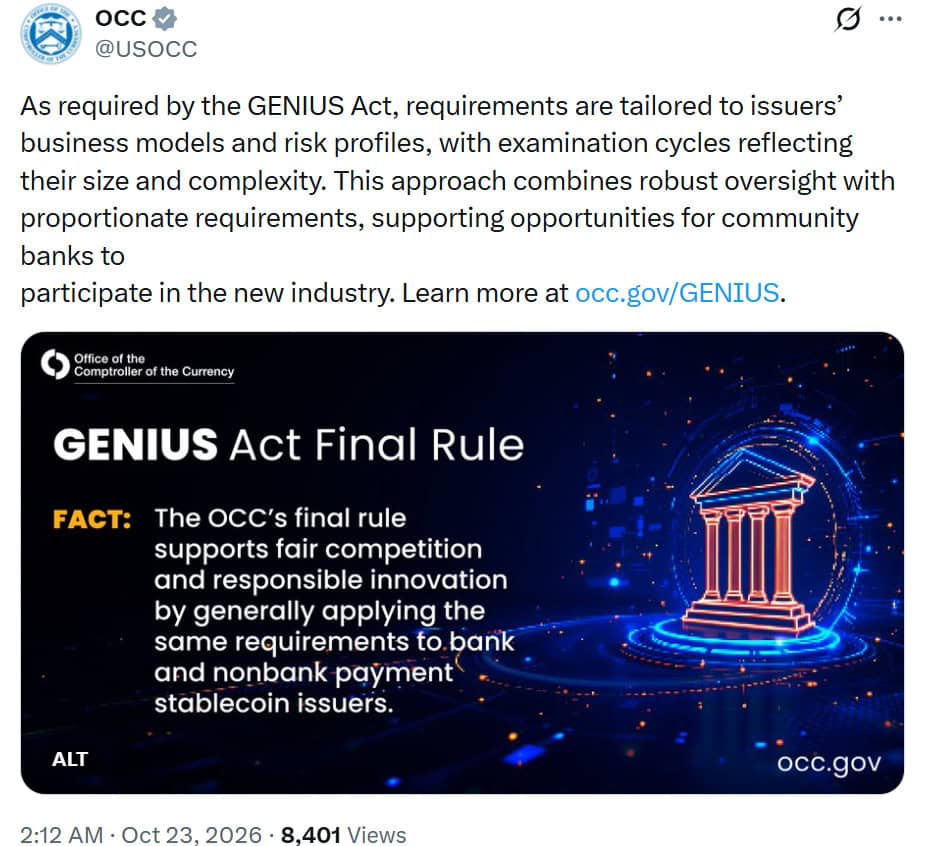
The OCC’s GENIUS Act rule tailors stablecoin issuer necessities and examination schedules to every entity’s enterprise mannequin, danger profile, dimension, and complexity. Supply: @USOCC by way of X
The rule is scheduled to take impact on January 18, 2027, alongside the GENIUS Act. It covers nationwide banks, federal financial savings associations, federal branches, and their subsidiaries, in addition to sure nonbank and overseas issuers beneath OCC jurisdiction.
The framework units requirements for reserve property, redemption rights, danger administration, audits, reporting, custody, and capital safeguards. Fee stablecoins should be backed by qualifying reserve property beneath the regulation, with necessities designed to assist redemption and cut back dangers to holders.
The OCC can be adopting a proportionate supervisory method, tailoring examinations to elements similar to an issuer’s enterprise mannequin, dimension, complexity, and danger profile. The framework is meant to keep up oversight whereas permitting eligible neighborhood banks to take part within the cost stablecoin market.
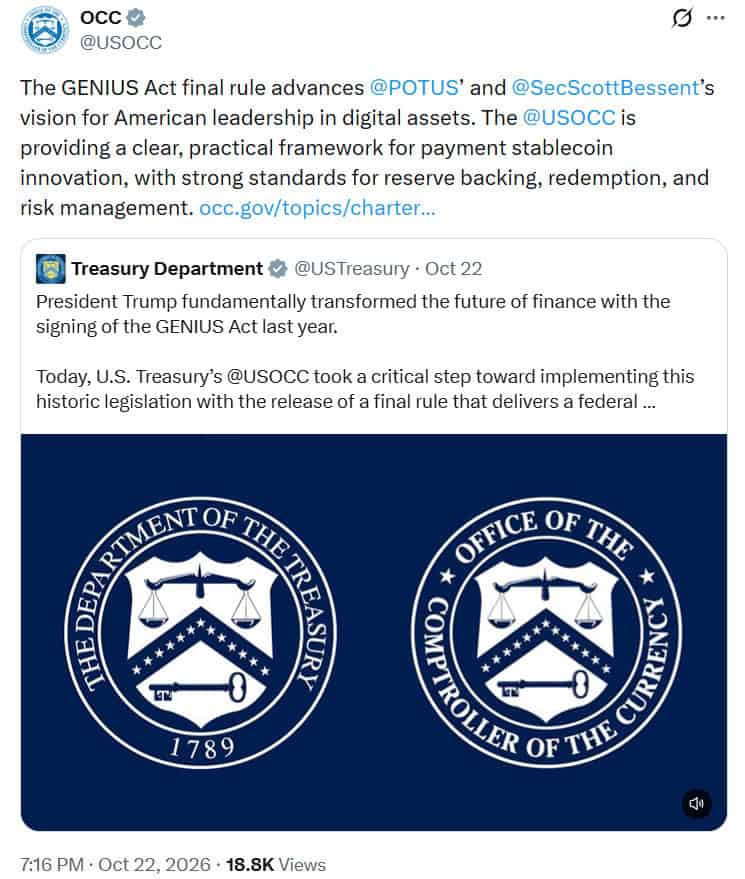
The GENIUS Act restricts stablecoin issuance to permitted entities whereas strengthening client protections and the greenback’s position in digital property. Supply: @USOCC by way of X
Extra reporting necessities will assist supervisors monitor issuers’ monetary situation and compliance. The OCC has developed weekly and quarterly reporting kinds, which stay topic to relevant information-collection approval necessities.
Anti-money-laundering and sanctions necessities are being addressed by means of separate regulatory processes involving the related federal authorities.
The OCC framework doesn’t decide whether or not XRP is a safety, and Ripple’s SEC submission doesn’t alter the GENIUS Act’s stablecoin necessities. The developments nonetheless spotlight two parallel regulatory priorities: defining securities-law obligations for crypto property and establishing safeguards for cost stablecoins.
The subsequent milestones are the SEC’s overview of feedback on Regulation Crypto Belongings and the GENIUS Act framework’s implementation in January 2027. Their eventual results will depend upon the ultimate securities guidelines, the scope of the OCC’s necessities, and the way the respective companies implement them.
Ahmed Ishtiaque Ahmed Ishtiaque Read More