
Key takeaways
- Anza instructed Solana mainnet operators, staked and unstaked, to put in Agave validator shopper v4.4.2 instantly.
- The builders stated the community was persevering with to function usually; the discharge doesn’t by itself point out an outage, exploit or assault.
- The precise technical problem behind the pressing launch has not been absolutely established.
- Validator listing knowledge reveals blended software program variations, however no verified breakdown of v4.4.2 adoption is obtainable but.
- The discover is geared toward node operators, not pockets holders, and doesn’t by itself require SOL customers to take any motion.
Solana builders have issued an pressing instruction to community operators, asking them to put in the most recent model of the Agave validator shopper directly.
The announcement from Anza, the event crew answerable for sustaining Agave, applies to each staked and unstaked nodes working the affected software program. The builders additionally indicated that the community was persevering with to function usually.
The announcement follows a sequence of Solana validator software improvements launched earlier this month, together with additional growth of Agave and Firedancer.
An pressing software program replace doesn’t essentially imply {that a} blockchain is experiencing an outage. In Solana’s case, the extra attention-grabbing query is how shortly its distributed community of operators can reply when builders determine an issue that can’t look ahead to a routine improve.
What Is Behind Solana’s Pressing Improve?
Anza directed operators to put in model 4.4.2 of its validator software program, telling them in its announcement:
“
Don’t wait, improve now.
Anza · Agave v4.4.2 improve discover
The discharge is documented in Anza’s official GitHub repository, whereas appropriate builds have additionally reportedly been made accessible by Jito-Solana and Harmonic.
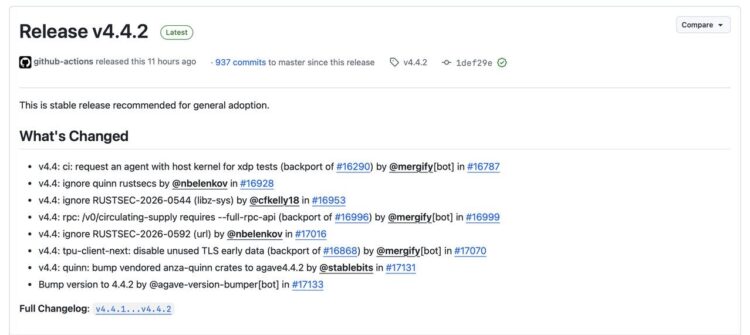
Agave is among the software program implementations answerable for processing transactions and taking part in Solana’s consensus mechanism. Validators working it assist decide which transactions turn into a part of the blockchain.
In contrast to updating an software on a telephone, updating validator software program includes coordinating machines operated by unbiased organizations all over the world. Builders can launch a brand new model, however the operators themselves should deploy it.
Community monitoring knowledge from Validator Data reveals that each Agave 4.4.2 and Jito 4.4.2-jito have been launched, whereas Firedancer’s newest listed model is 26.11.1. The supply of those releases doesn’t, nonetheless, set up what number of validators have put in them.

That makes the pace of adoption virtually as attention-grabbing as the discharge itself.
A verify of the Solana validator directory reveals operators reporting totally different software program variations, together with Agave-derived implementations. Nevertheless, a whole and independently verified breakdown of the most recent improve’s adoption was not but accessible.
The exact technical problem behind Anza’s pressing instruction stays to be absolutely established. Describing the discharge as a response to an exploit or an energetic community assault would subsequently be untimely.
Solana’s Latest Upgrades Face a Completely different Form of Take a look at
The announcement comes simply weeks after Solana launched vital modifications to its underlying infrastructure.
As NewsBTC beforehand reported, the Solana Foundation introduced protocol version 1.0 in November and moved away from describing the community as mainnet beta.
The excellence between the protocol model and the validator software program model is essential. Solana can set up a standard set of community guidelines whereas particular person software program implementations proceed to obtain updates and fixes.
The community has additionally been pursuing sooner transaction processing and shorter affirmation instances via its Alpenglow consensus structure.
These enhancements are beneficial, however sooner transactions are solely helpful if the infrastructure processing them stays reliable.
What Does the Improve Imply for SOL Holders?
For atypical customers, Anza’s instruction is geared toward node operators quite than pockets holders. The announcement doesn’t, by itself, set up a necessity for customers to maneuver their SOL or change how they work together with the community.
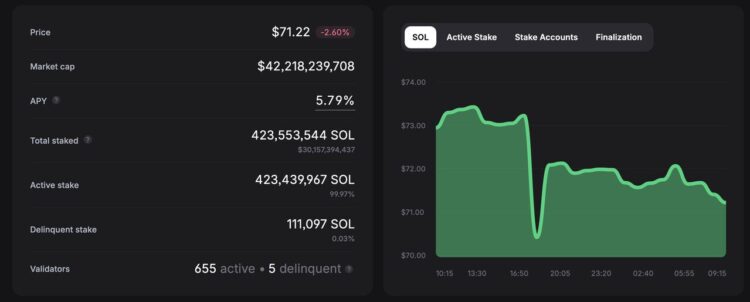
On the time of the dashboard snapshot, Solana had 655 energetic validators and 5 listed as delinquent. Roughly 423.44 million SOL was actively staked, representing 99.97% of the reported whole stake. The figures supply a snapshot of community participation whereas operators are being requested to replace their software program, though they don’t independently verify the success of the improve.
The following significant growth will probably be proof that operators have put in the brand new launch and that transaction processing stays steady all through the rollout.
Solana has spent appreciable time demonstrating how briskly its community can turn into. This weekend’s improve affords one other alternative to evaluate one thing equally essential: how properly its infrastructure responds when pace is required exterior of regular transaction processing.
Tomás Rivas Read More