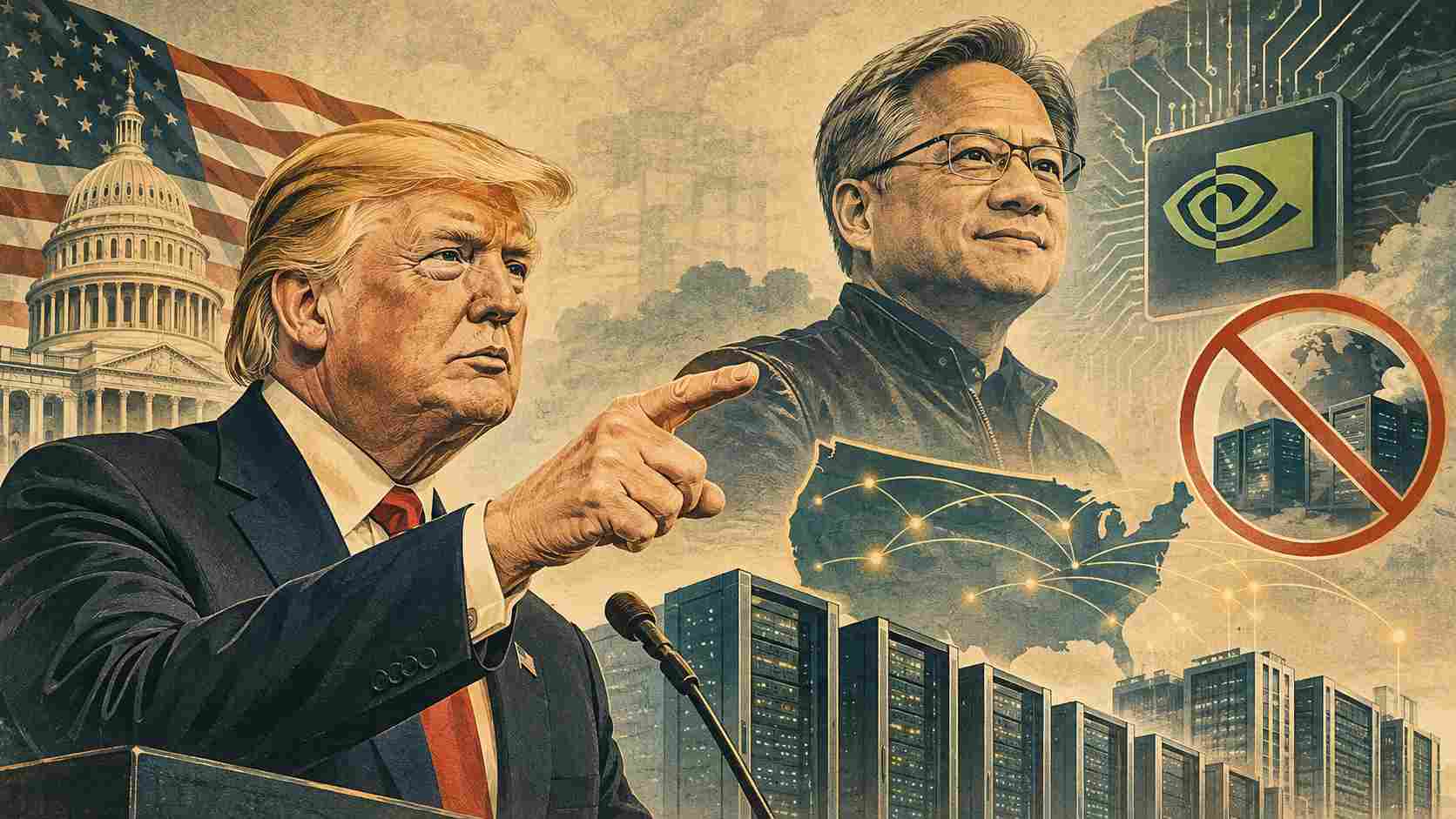
The comments, made throughout a White Home press convention on November 20, spotlight two priorities for the administration: conserving synthetic intelligence infrastructure inside the US and sustaining its aggressive place in opposition to China.
Trump Proposes Tax on Abroad AI Knowledge Facilities
Trump mentioned his administration would forestall American firms from establishing information facilities outdoors the nation or impose a considerable monetary penalty on people who proceed. Referring to the proposed measure, he warned that firms constructing services overseas would face a “large tax.”
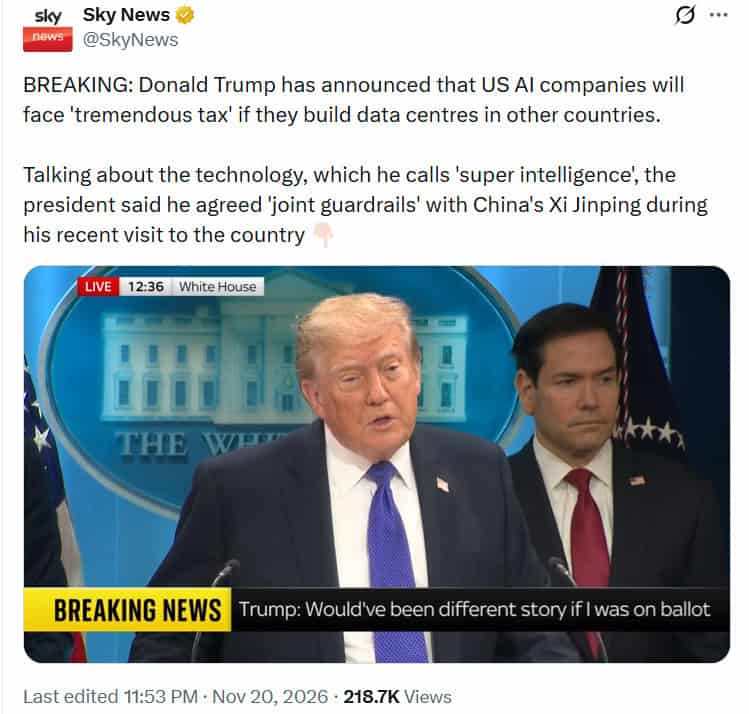
President Trump proposed a hefty tax on US AI companies constructing information facilities abroad to guard home infrastructure and jobs amid rising competitors with China. Supply: @SkyNews/X
“We’re not going to permit our firms to construct information facilities outdoors of our nation,” Trump mentioned through the press convention.
The president argued that permitting essential know-how infrastructure and manufacturing operations to maneuver abroad might weaken America’s place within the international AI race. He pointed to the semiconductor trade for example, suggesting that the US had fallen behind after permitting chip manufacturing to develop overseas.
The proposal displays Trump’s broader effort to draw funding, infrastructure improvement, and technology-related employment to the home market. Nevertheless, he didn’t present a proposed tax fee, implementation schedule, or particulars about which firms and tasks would fall beneath the measure.
The announcement additionally got here with questions on its authorized and administrative feasibility. In accordance with Axios, Trump acknowledged that he had not mentioned the proposal along with his officers earlier than making the announcement. The president additionally didn’t clarify whether or not he would search congressional approval or try to make use of current govt powers.
The US Structure grants Congress authority to impose federal taxes, leaving the exact authorized route for Trump’s proposed measure unresolved. No formal legislative framework or implementing rules had been outlined through the announcement.
Home Knowledge Middle Enlargement Faces Public Opposition
Trump’s proposal comes because the fast enlargement of AI infrastructure faces rising resistance in a number of US communities. Though the administration needs firms to construct extra services domestically, the tasks have generated issues about electrical energy consumption, water necessities, and their potential impression on family utility prices.
Knowledge facilities require substantial computing capability to coach and function more and more refined AI fashions. Their electricity demand can place extra strain on native energy networks, whereas cooling programs can require important water assets. These points have change into outstanding topics in native planning discussions and election campaigns.
The backlash additionally turned a political challenge through the 2026 midterm election cycle, with voters contemplating measures to limit or impose extra situations on information heart improvement. Consequently, Trump’s effort to discourage abroad development comes at a time when some American communities are questioning the prices of internet hosting these services.
There’s additionally an financial consideration. Knowledge heart operators regularly set up services near prospects to scale back processing delays and the expense of transmitting massive volumes of data. For firms serving worldwide shoppers, sustaining infrastructure throughout totally different nations can due to this fact stay essential.
A coverage that will increase the price of abroad development might affect future funding choices by US know-how companies. Nevertheless, its final impression would rely on the scope of the proposed tax and whether or not firms obtain any exemptions.
Trump Highlights AI Competitors With China
Trump linked his information heart proposal to the broader competitors between Washington and Beijing over synthetic intelligence. Throughout the identical press convention, he mentioned his latest Asia journey and his conversations with Chinese language President Xi Jinping.
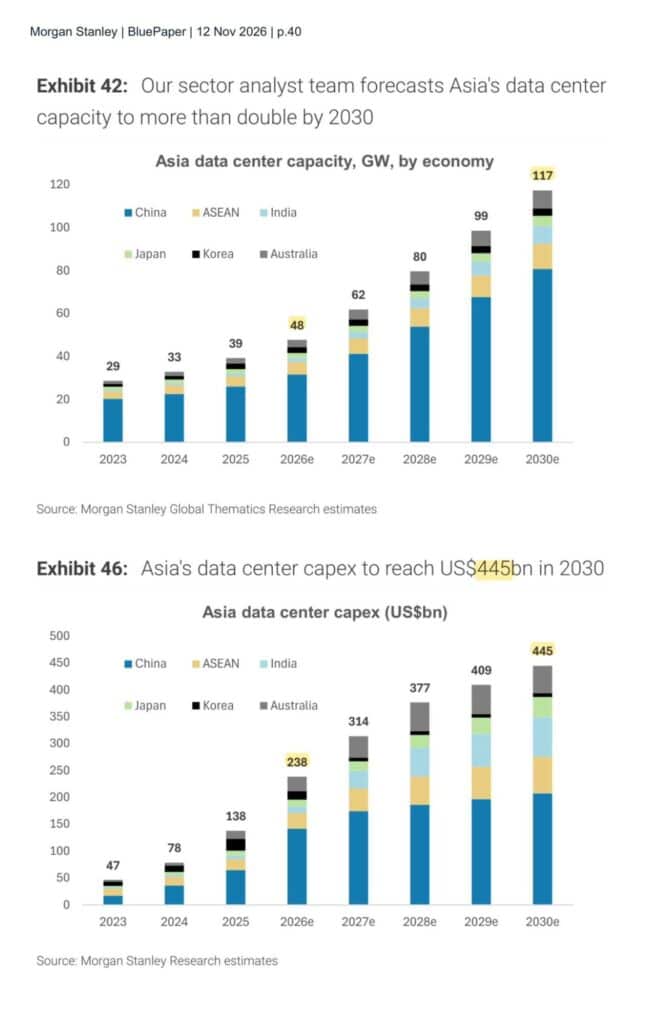
Morgan Stanley is projecting capability to climb from 48 GW in 2026 to 117 GW by 2030. Supply: @MojoTricks/X
The president claimed that he and Xi had agreed to ascertain “joint guardrails” for AI improvement. He didn’t clarify what these safeguards would contain or whether or not they would result in any formal settlement between the 2 governments.
Trump additionally described synthetic intelligence as “tremendous intelligence,” arguing that the US remained forward of China within the race to develop the know-how. He offered the competitors as largely revolving across the two nations, with China occupying second place in his evaluation.
The feedback come amid persevering with US efforts to limit China’s entry to superior computing know-how. The Commerce Division has moved to tighten controls on superior AI chip exports to a number of Southeast Asian nations to stop the know-how from reaching Chinese language firms by means of third-party channels.
Knowledge facilities have change into a part of this broader know-how competitors as a result of they permit companies to entry highly effective processors and computing assets with out essentially buying the {hardware} themselves. Reuters has reported that Chinese language firms have continued accessing computing capability by means of abroad information facilities in nations permitted to obtain superior chips.
This creates a connection between Trump’s proposed tax and the administration’s semiconductor insurance policies. Each approaches search to guard America’s technological place whereas limiting the channels by means of which China can entry superior AI computing assets.
Trump Requires Jensen Huang’s Return to Nvidia
Alongside his feedback about AI infrastructure, Trump renewed his assist for Jensen Huang’s return as Nvidia chief govt.
Huang resigned from his positions as president, CEO, and board member on November 12, 2026, following reports involving alleged extramarital relationships. Nvidia’s board subsequently appointed Chief Monetary Officer Colette Kress as interim CEO whereas starting the seek for a everlasting alternative.
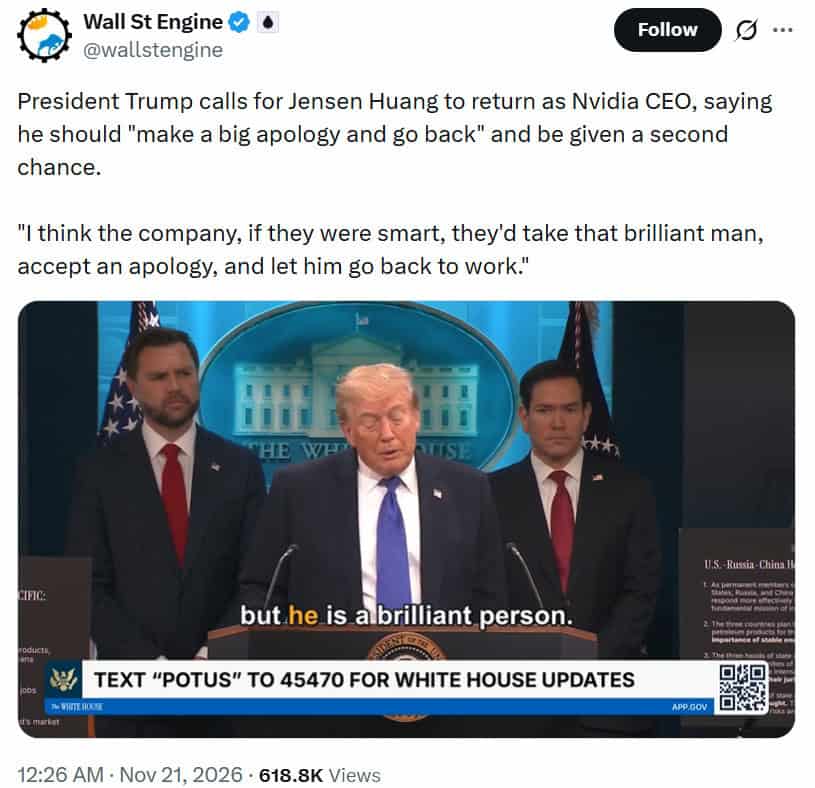
President Trump referred to as on Nvidia’s board to reinstate Jensen Huang as CEO, urging it to simply accept his apology and provides him one other alternative. Supply: @wallstengine/X
Trump described Huang as some of the gifted figures within the know-how trade and argued that Nvidia ought to think about giving him one other alternative to steer the corporate.
“I’d like to see him again,” Trump mentioned, including that Huang ought to “be given a second likelihood.”
The president additionally advised that Nvidia ought to settle for an apology from its former chief govt and permit him to return to work. He credited Huang with serving to develop the corporate’s superior Blackwell AI chip platform, which has change into an essential a part of its computing enterprise.
Trump additional argued that Huang’s technical contributions had helped put the US considerably forward in AI chip improvement. His remarks mirrored concern about shedding an govt whose work has been intently related to Nvidia’s enlargement within the international semiconductor trade.
The feedback adopted an earlier wave of assist for Huang from know-how trade figures and traders. Elon Musk and Epic Video games CEO Tim Sweeney had been amongst those that backed a petition calling for Nvidia to rethink the choice whereas an impartial investigation proceeds.
Nvidia Board Maintains Management Transition
Regardless of Trump’s public backing, Huang’s return to Nvidia doesn’t look like a part of the board’s present plans. The Related Press reported that an individual acquainted with the board’s pondering mentioned administrators weren’t contemplating reinstating the previous CEO.
The circumstances surrounding Huang’s resignation stay delicate. Studies described alleged relationships with a senior Nvidia govt who reported to him and a Chinese language businesswoman suspected by US intelligence of getting connections to Beijing. The latter allegation has not been publicly established as truth, and Trump has questioned whether or not the girl was a spy.
The difficulty has additionally raised questions on company governance, govt conduct, and potential nationwide safety issues. Nvidia’s board now faces the duty of sustaining confidence amongst traders, workers, and prospects whereas the corporate searches for everlasting management.
The administration itself has proven differing views on the corporate’s future. Treasury Secretary Scott Bessent beforehand referred to as for a major management shake-up and advised that Nvidia ought to think about an exterior candidate. Trump’s endorsement of Huang’s return due to this fact contrasts with Bessent’s said desire for a special management path.
For now, Colette Kress stays chargeable for Nvidia’s govt management whereas the board considers potential successors. The corporate has mentioned it expects operations, buyer commitments, and its product roadmap to proceed with out interruption.
Trump’s two bulletins spotlight the administration’s rising deal with the strategic significance of AI infrastructure and semiconductor management. Nevertheless, the proposed abroad information heart tax nonetheless lacks an implementation framework, whereas Huang’s potential return is determined by a choice by Nvidia’s board fairly than presidential assist alone.
Ahmed Ishtiaque Ahmed Ishtiaque Read More